 Short Communication
 Validation of a New Non-invasive Personalized RS-Skin Carotenoid Scanner (Prysm iO) versus the BioPhotonic Scanner S3 RRS Device for Estimating Carotenoid Levels in Humans
by Melanie Riggs1, Helen Knaggs1, Edwin D Lephart2*, Tanner Gibb1, Zoe D Draelos3
1NSE Products, Inc. Provo, Utah, 84601, USA
2Department of Cell Biology, Physiology and The Neuroscience Center, College of Life Sciences, Brigham Young University, Provo, Utah, 84602, USA
3President, Dermatology Consulting Services, PLLC; 2444 N. Main Street, High Point, North Carolina, 27262, USA
*Corresponding author: Edwin D Lephart, Department of Cell Biology, Physiology and The Neuroscience Center, College of Life Sciences, Brigham Young University, Provo, Utah, 84602, USA
Received Date: 23 December 2025
Accepted Date: 1 January 2026
Published Date: 5 January 2026
Citation: Riggs M, Knaggs H, Lephart ED, Gibb T, Draelos ZD (2025) Validation of a New Non-invasive Personalized RS-Skin Carotenoid Scanner (Prysm iO) versus the BioPhotonic Scanner S3 RRS Device for Estimating Carotenoid Levels in Humans. Food Nutr J 10: 334. https://doi.org/10.29011/2575-7091.100334
Abstract
Humans cannot synthesize carotenoids; they must be obtained through dietary sources and/or by nutraceutical supplementation. Carotenoids have been linked to reducing the risk of age-related diseases, promoting healthy aging, and enhancing dermal health. Emerging technologies over the last 20 years have provided non-invasive alternative methods to determine carotenoid antioxidant levels by scanning the skin via spectroscopy measurements. Therefore, the objective of this report is to present the results of a clinical study analyzing the correlation between Skin Carotenoid Scores (SCS) measured with the established BioPhotonic Scanner S3 versus a new novel compact personalized scanner (Prysm iO), and via quantified serum carotenoid levels (SCL, measured in µg/ml) in adult men (n = 28) and women (n = 69). The correlation from the S3 BioPhotonic Scanner between SCS and SCL was R2 = 0.7789. The correlation from the Prysm iO between SCS and SCL was R2 = 0.7659, showing very similar relationships between SCS and SCL in both devices. In conclusion, this report introduces an alternative technology based on custom built Reflectance Spectroscopy (RS) which is small, personalized, and inexpensive and allows individuals to scan their skin in order to know their carotenoid levels, then make changes in their dietary intake to enhance health, wellbeing, and lifespan.
Keywords: RS Technology; Scanner; Carotenoids; Levels; Human
Abbreviations:
µg : microgram
R2 : coefficient of determination
FVC : fruit and vegetable intake
HPLC : high-performance liquid chromatography
ml : milliliter
MS : mass spectrometry
NFkB : nuclear factor kappa B
RIU S3 : Raman Intensity Units
RIU Prysm iO : Reflectance intensity units
RRS : Resonance Raman Spectroscopy
RS : Reflectance Spectroscopy
SCL : serum carotenoid levels
SCS : skin carotenoid score
SIRT 1 : NAD-dependent deacetylase sirtuin-1
Introduction
Carotenoids are naturally occurring pigments found in plants, particularly fruits and vegetables that have antioxidant activities [1-3]. Well-known experimental research has demonstrated that oxidative stress is the leading cause of the onset and progression of major human health disorders [1-3]. Humans cannot synthesize carotenoids and must ingest them from foods or by nutraceutical supplementation [1-3]. Once carotenoids are consumed, they are metabolized and then deposited into the blood, skin, and tissues of the body, where they exhibit antioxidant activity due to their ability to neutralize free radicals. Traditionally, the standard method for monitoring carotenoid levels has been to analyze blood samples using High-Performance Liquid Chromatography (HPLC) along with Mass Spectrometry (MS), which makes the process invasive, expensive, and time-consuming [2-4]. However, emerging technologies over the last 20 years have provided noninvasive alternatives to determine carotenoid antioxidant levels by scanning the skin via spectroscopy measurements to quantitatively estimate the dietary intake of carotenoids in diverse populations of adults and children.
Early development of non-invasive alternatives focused on Resonance Raman Spectroscopy (RRS) technology. In brief, the BioPhotonic Scanner S3 uses a blue wavelength of light at 478 nm to excite carotenoids in the skin to provide a spectral signature that quantifies carotenoid levels in the skin [5-8]. The BioPhotonic Scanner translates this Raman signal into Raman Intensity Units (RIU), which are reported as a number and color on a standardized scale for ease of tracking and comparing scores over time. The scoring results range from 10,000 to 89,000+ RIU, with 32,000 RIU being an approximate average score [8].
RRS technologies are non-invasive, rapid (taken within seconds), do not require specialized training or data processing (compared to blood sample analysis), and have been shown to correlate with plasma carotenoid levels in several research investigations [6,7,9-11]. However, even with technological improvements and advances to RRS devices over the last 20 years, such devices are still relatively bulky and expensive to manufacture. These drawbacks mean that accessibility to RRS devices is restricted due to their limited numbers. Since skin carotenoid concentration correlates with levels of FVC, it would be of public interest to have this technology more readily available on a personalized basis. This short report introduces an alternative technology based on Reflectance Spectroscopy (RS) which overcomes many of the issues with RRS devices.
Objective: The objective of this clinical study is to analyze correlations between skin carotenoid scores (SCS) from the established BioPhotonic Scanner S3, SCS from a new novel compact personalized scanner (Prysm iO), and quantified serum carotenoid levels from blood.
Methods
Adult men and women (n = 97) were recruited to participate in this validation study. The demographics of the subjects included 28 males and 69 females. The mean participant age was 49 years (range: 22–77). The participants a) filled out consent form to process an individual’s data relating to their health and ethnicity for research and statistical purposes and b) answered a survey that contained demographic information such as birthdate, and sex, height/weight, which was approved by the Allendale Institutional Review Board on October 30, 2025, with the assigned study number (DCS-68-25). The study was conducted in accordance with the ethical principles of the 1975 Declaration of Helsinki and its subsequent amendments. Prior to the performance of any study procedures, subjects were provided with an explanation of the nature of the study, including the purpose, procedures, expected duration, and potential risk. Prospective subjects were informed of their right to withdraw from the study at any time without being obliged to give a reason.
SCS was quantified using the BioPhotonic Scanner S3 by placing the right index finger of each subject on the scanner probe for 30 seconds until the data-readout was obtained. SCS was obtained using the Prysm iO by placing the right index finger on the scanning lens for 15 seconds until the data-readout was obtained.
A blood sample was drawn from each subject at the antecubital vein to determine the serum carotenoid levels (SCL) (µg/ml) by using High-Performance Liquid Chromatography (HPLC) along with Mass Spectrometry (MS) [2-4].
For each subject the scanner score and the quantified serum carotenoid levels were analyzed using a coefficient of determination (R2), which is a statistical measure that not only evaluates the strength but also direction of the relationship between two continuous variables.
Results
For the BioPhotonic Scanner S3 data, the correlation between SCS and SCL was R2 = 0.7789. SCS ranged from 10,000 to 83,000 and SCL ranged from 0.357 to 5.65 µg/ml (see Figure 1).
For the Prysm iO data, the correlation between SCS and SCL was R2 = 0.7659. SCS ranged from 49 to 1112 and SCL ranged from 0.357 to 5.65 µg/ml (see Figure 2), which was similar to the results obtained with the BioPhotonic Scanner S3. Importantly for both the Prysm iO and S3, SCS were strongly and positively associated with serum carotenoid levels, demonstrating the effectiveness of these devices as reliable methods for evaluating systemic carotenoid levels.
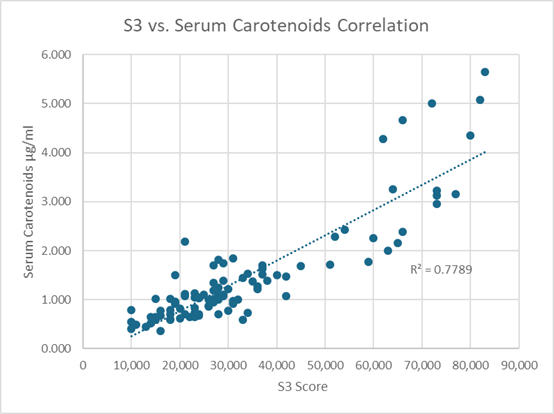
Figure 1: Correlation between BioPhotonic Scanner S3 Skin Carotenoid Scores (SCS) in Raman Intensity Units (from 0 to 90,000) and quantified Serum Carotenoid Levels (SCL) (in µg/ ml).
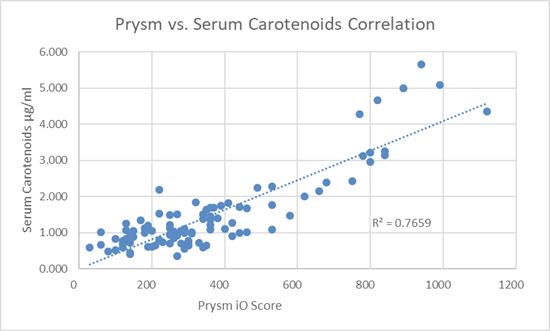
Figure 2: Correlation between Prysm iO Skin Carotenoid Scores (SCS) in Reflectance Intensity Units (0 to 1200) and quantified Serum Carotenoid Levels (SCL) (in µg/ml).
Discussion
The present study evaluated the relationship between noninvasive skin carotenoid measurements and serum carotenoid concentrations across different optical devices: Prysm iO and the BioPhotonic Scanner S3. For both devices, skin carotenoid scores were strongly and positively associated with serum carotenoid levels, demonstrating the effectiveness of these devices as reliable methods for estimating circulating carotenoid levels.
Carotenoids have been reported to act through a variety of mechanisms to enhance health and wellbeing that include a) increasing the antioxidant capacity and decreasing reactive oxygen species, b) decreasing the risk of cardiovascular disease, c) increasing skin health and act as a ultraviolet protectant, d) increasing immune health, e) increasing bone health, f) decreasing metabolic syndrome and type 2 diabetes, and g) decreasing the risk of neurodegenerative disorders like Alzheimer’s disease [12]. Additionally, carotenoids may enhance SIRT1 activity, a critical enzyme linked to cellular longevity plus stress resistance while at the same time can reduce chronic inflammation contributing to agerelated disease by inhibiting NFkB signaling [12-14]. Carotenoids also improve mitochondrial function through their antioxidant activity by reducing oxidative damage and enhancing cellular energy metabolism [1-4,12,15]. There are numerous reports that have demonstrated the health benefits of the dietary intake of carotenoids via foods and/or nutraceutical supplementation [14,7,12,13,15,16]. As such, it would be beneficial for the general population to have greater access to this technology to quickly measure carotenoids. In fact, a recent review [12] summarized findings from a database of global skin carotenoid scores from more than 20 different countries. It showed correlations between dietary intake of carotenoids from fruits, vegetables, and nutraceutical supplementation and SCS, as well as correlations between certain lifestyle choices and SCS (particularly obesity and smoking) [12].
The present validation study demonstrated that a new compact skin carotenoid scanner, Prysm iO, allows individuals to estimate SCS quickly and accurately. Notably, when the clinical results were compared between the BioPhotonic Scanner S3 and the Prysm iO, the two correlations of SCS to SCL were similar. The results obtained demonstrate that both correlation plots were close in slope, range, and profile for estimating carotenoid levels. Thus, the Prysm iO can provide individuals an accurate estimate of skin carotenoid levels as a biomarker for overall antioxidant status, which in turn can encourage lifestyle adjustments in their dietary/ supplemental intake to support long-term health and wellness [17,18].
Conclusions
In this clinical validation study, correlations between the SCS from two skin carotenoid scanners were compared to SCL to determine whether the devices were similarly effective at estimating systemic carotenoid levels. The obtained results demonstrated that the Prysm iO was equivalent to the established BioPhotonic Scanner S3 to estimate carotenoid levels in humans to benefit their health, wellness, and lifespan.
Acknowledgments:
This research was funded by NSE Products Inc. and, in part, by the College of Life Sciences at Brigham Young University (grant # 19-221)
Ethical Considerations:
Ethics approval and consent to participate: Informed written consent was obtained from all participants to use their data in scientific reports following institutional review board protocols and the ethical principles of the Helsinki Declaration.
Conflict of Interest:
The authors declare no conflicts of interest. The funders had no role in the design, presentation, collection of research information and scientific references, or in the analysis, interpretation of the presented data/information, in the writing of the manuscript; or in the decision to publish the contents of this article.
References
- Roa AV, Rao LG (2007) Carotenoids and human health. Pharmacol Res 55: 207-216.
- Crupi P, Faienza MF, Naeem MY, Corbo F, Clodoveo ML, et al. (2023) Overview of the potential beneficial effects of carotenoids on consumer health and well-being. Antioxidants 12: 1069.
- Bakac ER, Percin E, Gunes-Bayir A, Dadak A (2023) A narrative review: The effects and importance of carotenoids on aging and agingrelated diseases. Int J Mol Sci 24: 15199.
- Terao J (2023) Revisiting carotenoids as dietary antioxidants for human health and disease prevention. Food Function 14: 7799-7824.
- Ermakov IV, Ermakova M, Sharifzadeh M, Gorusupudi A, Farnsworth K, et al. (2018) Optical assessment of skin carotenoid status as a biomarker of vegetable and fruit intake. Arch Biochem Biophys 646:46-54.
- Radtke MD, Pitts SJ, Jahns L, Firnhaber G, Loofbourrow BM, et al. (2020) Criterion-related validity of spectroscopy-based skin carotenoid measurements as a proxy for fruit and vegetable intake: A systematic review. Adv Nutr 11: 1282-1299.
- Obana A (2025) Measurement of skin carotenoids and their association with disease: A narrative review. BBA Mole Cell Biol Lipids 1870: 159612.
- Nu Skin RRS technology BioPhotonic S3 Scanner website: https://doi. org/10.1016/j.bbalip.2025.159612.https://www.nuskin.com/content/nuskin/en_US/products/pharmanex/ scanner/s3_score.html Accessed 12 DEC 2025.
- Amoah I, Cairncross C, Rush E (2023) Vegetable-enriched bread: Pliot and feasibility study of measurement of changes in skin carotenoid concentrations by reflection spectroscopy as a biomarker of vegetable intake. Food Sci Nutr 11: 3376-3384.
- Wu Q, Cherry CW, Pitts SJ, Laska MN, Craft N, et al. (2025) A reflection-spectroscopy measured skin carotenoid score strongly correlates with plasma concentrations of all major dietary carotenoids species except for lycopene. Nutr Res 133: 127-137.
- Ermakov I, Gellerman W (2015) Optical detection methods for carotenoids in human skin. Arch Biochem Biophys 572: 101-111.
- Knaggs H, Barrett J, Fisk N, Ferguson S, Riggs M, Lephart ED (2025) Assessing global lifetime skin carotenoids scores (20032025) implications to wellness, lifestyle factors potentially enhance or diminish healthspan – A narrative review. Advances Preventive Medicine Health Care 8: 1084.
- Bhatt T, Patel K (2020) Carotenoids: Potent to Prevent Diseases Review. Nat Prod Bioprospecting 10: 109-117.
- Liguori I, Russo G, Curcio F, Bulli G, Aran L, et al. (2018) Oxidative stress, aging and disease. Clin Interventions Aging 13: 757-772.
- Gomez-Sagasti MT, Lopez-Pozo M, Artetex U, Becerrill JM, Hernandez A, et al. (2023) Carotenoids and their derivatives: A “Swiss Army knifelike” multifunctional tool for fine-tuning plant-environment interactions. Environmental Exp. Botany 206: 105229, pages 1-14.
- Bas TG (2024) Bioactivity and bioavailability of carotenoids applied in human health: Technological advances and innovation. Int J Mol Sci 25: 7603.
- Rippe JM (2018) Lifestyle Medicine: The health promoting power of daily habits and practices. Am J Lifestyle Med 12: 499-512.
- Tessier A-J, Wang F, Korat AA, Eliassen AH, Chavarro J, et al. (2025) Optimal dietary patterns for healthy aging. Nat Med 31: 1644-1652.
© by the Authors & Gavin Publishers. This is an Open Access Journal Article Published Under Attribution-Share Alike CC BY-SA: Creative Commons Attribution-Share Alike 4.0 International License. Read More About Open Access Policy.