 Opinion Article
 Endogenous Morphine, Dopamine, GLP-1, and Nitric Oxide Signaling in Human Physiology: Implications for Mind–Body and Complementary Medicine
by George B. Stefano*
Mind-Cell LLC, Baltimore, MD, USA
*Corresponding author: George B. Stefano, Mind-Cell LLC, Baltimore, MD, USA.
Received Date: 15 April 2026
Accepted Date: 20 April 2026
Published Date: 22 April 2026
Citation: Stefano GB (2026) Endogenous Morphine, Dopamine, GLP-1, and Nitric Oxide Signaling in Human Physiology: Implications for Mind–Body and Complementary Medicine. Curr Res Cmpl Alt Med 10: 282. DOI: https://doi.org/10.29011/2577-2201.100282
Abstract
There is growing evidence indicating that endogenous morphine, dopamine, nitric oxide, and GLP-1 belong to an integrated physiological system of signaling mechanisms that facilitate proper functioning of the mind, motivation, emotions, and metabolism. Instead of regarding these compounds as primarily being involved in pathological conditions, in this Opinion it is put forward the hypothesis that these signaling pathways are associated with evolutionarily conserved systems governing the interplay between brain functions, metabolism, and cellular energetics. The coordination between such aspects of physiology as energy acquisition, emotions, stress adaptation, and mitochondrial metabolism seems to be a major focus for research related to mind-body medicine.
Keywords: Mind-body medicine; Complementary medicine; Dopamine; Nitric oxide; Mitochondria; Endogenous morphine
Introduction
Endogenous morphine is no longer considered to be biologically implausible as it has been proven to be produced in living cells of animals. Furthermore, it is known to be synthesized from dopamine, another physiologically active signaling molecule [1-4]. Thus, it is quite obvious that dopamine and morphine are two evolutionarily conserved and interrelated systems rather than being independent of each other. Indeed, dopamine is well-known as a mediator controlling motivation, rewards, motor activities, and behavioral conditioning while endogenous morphine facilitates cellular excitability and homeostasis [5-7].
Taking into account another group of compounds like nitric oxide, a gaseous signaling molecule affecting vascular tone, mitochondrial respiration, and synaptic plasticity, and GLP-1, a hormonal signaler regulating appetite, reward, and metabolic processes, it becomes clear that we can speak about some kind of integration among all these signaling pathways. The importance of this issue can hardly be overestimated especially in the context of mind-body and complementary medicine.
A Physiological Framework for Motivation, Emotion, and Energy Regulation
The role of dopamine in the formation of adaptive behaviors is mediated through the link between environmental triggers and their association with motivation and goal-directed action [8]. Physiologically, this manifests in functions such as learning, anticipation, reward evaluation, and work. All these are critical both for survival and psychological well-being since they underlie mood, drive, and resilience. Morphine produced endogenously could be seen as balancing the activity of dopamine by means of selective receptor interaction and nitric oxide-mediated control. Morphinergic modulation of neuronal activity through selective stimulation is believed to be necessary for emotional stability by limiting excessive activation of dopaminergic neurotransmission [6,9]. Instead of inhibition, the use of morphine endogenously could be interpreted as optimal regulation by setting functional limits to activity.
Significantly, nitric oxide mediates another important process, integrating neurotransmitter functions with cellular energy metabolism. By modulating cytochrome c oxidase, nitric oxide influences oxidative phosphorylation and energy generation, allowing the match between energy expenditure of neuronal activity and cellular metabolic capacity [10,11]. This process ensures dynamic integration of psychological functions and energy metabolism which is necessary for adaptive mind–body regulation.
GLP-1 Signaling and Integrative Behaviors and Metabolism
GLP-1 signaling pathway is also critical for adaptive mind–body regulation through integration of metabolic and neurological regulation. Receptors for GLP-1 are distributed in areas related to the reward pathway, such as the ventral tegmental area and nucleus accumbens [12,13]. Activation of these receptors leads to modulation of dopaminergic tone and reduction of reward salience, thus supporting the regulation of behavior. What makes GLP-1 particularly relevant for behavioral adaptiveness is the fact that it promotes mitochondrial efficiency and decreases oxidative stress [14]. This leads to neuroprotective and metabolic stabilization effects, which allows GLP-1 signaling to integrate behavioral and energetic aspects of human functioning. Normal human physiology is characterized by appropriate satiety signaling and improved emotional regulation.
Clinical data from recent research show that modulation of GLP-1 receptor activity can lead to decreased maladaptive reward behaviors, as well as metabolic stabilization [15,16]. It demonstrates that these processes continue to be relevant in adult humans. Thus, from the mind–body point of view, it could be used as a way to integrate behavioral and metabolic interventions at the same level of signaling.
Definitions and Conceptual Distinctions
A. Mind–Body MedicineMind–body medicine refers to a scientific and clinical discipline that examines how psychological, emotional, and social factors influence physiological processes and health outcomes. It emphasizes bidirectional communication between the brain and body and incorporates interventions such as stress reduction, mindfulness, exercise, and behavioral modification [17].
B. Complementary MedicineComplementary medicine refers to a diverse set of therapeutic approaches that are used alongside conventional medical treatments. These approaches include nutritional strategies, herbal therapies, acupuncture, and integrative behavioral practices, all of which aim to support systemic regulation and overall well-being.
C. SimilaritiesBoth mind–body medicine and complementary medicine emphasize holistic and systems-level approaches to health. Both recognize the importance of interactions between behavior, physiology, and environmental influences. Both aim to enhance resilience, adaptability, and self-regulation.
D. DifferencesMind–body medicine is generally grounded in psychophysiological mechanisms and is closely aligned with conventional scientific frameworks. Complementary medicine encompasses a broader range of practices, some of which derive from traditional or cultural systems and may vary in the level of empirical validation.
Implications for Mind–Body Medicine
The integration of signaling cascades involving dopamine, endogenous morphine, nitric oxide, and GLP-1 appears to serve as the basis for mind-body physiology (Figure 1). It can be surmised dopamine is involved in regulating motivation and reward pathways that shape adaptive behavior. Endogenous morphine serves to regulate emotions as well as neural excitability. Nitric oxide serves to regulate cell and vascular function via the mediation of mitochondrial respiration and signaling processes. GLP-1 serves to integrate metabolism and behavior by controlling energy balance and reward signaling.
In this regard, the combined action of these processes corresponds with the BERN approach, which focuses on behavioral intervention, exercise, relaxation, and nutrition for the maintenance of health [18]. Exercise affects dopaminergic and mitochondrial signaling while relaxation affects nitric oxide signaling and autonomic responses, and nutrition influences GLP-1 function. In each case, the treatment process is accomplished by affecting common biochemical processes, as opposed to independent processes. Thus, it can be seen that mind–body interventions have biological impact through conserved signaling cascades. This biological impact based in fundamental physiological principles, such as neural impulses (Figure 1) [19].
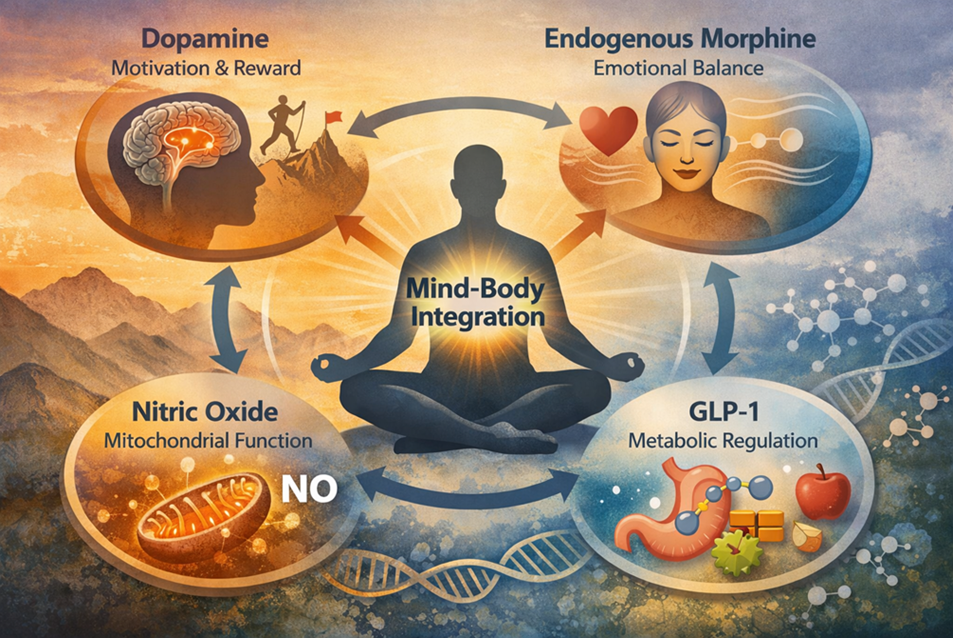
Figure 1: Conceptual integration of dopamine, endogenous morphine, nitric oxide, and GLP-1 signaling within a unified mind–body regulatory framework. Dopamine is depicted as the primary driver of motivation and reward-directed behavior, facilitating adaptive engagement with the environment. Endogenous morphine is shown as a modulatory system that regulates neuronal excitability and maintains emotional and physiological balance. Nitric oxide is positioned as a key mediator of mitochondrial function, dynamically regulating cellular respiration and oxidative balance. GLP-1 signaling is illustrated as an integrative pathway linking metabolic regulation with central reward circuits, thereby coordinating energy utilization and behavioral control. These interconnected systems converge on a central node representing mind–body integration, where behavior, energy metabolism, and emotional regulation are unified. The model highlights the bidirectional and cooperative nature of these signaling pathways in supporting physiological homeostasis and adaptive human function.
Mind-Body Medicine and Integrative Physiology
Mind-body and complementary medicine applies to the same signaling systems through non-pharmacological means such as meditative practices, dietary changes, exercise, and social behavior. The effect of meditative practices includes dopamine signaling, endogenous opioid regulation, nitric oxide production, and the regulation of metabolic hormones. Thus, behavioral treatments directly affect molecular signaling systems associated with physiological health and resistance to stressors. This is more advanced than biological medicine alone, in that it recognizes the importance of behavioral medicine. Evolutionarily speaking, these signaling pathways are optimal means of biological survival in a challenging environment.
Conclusion
Incorporating the roles of endogenous morphine, dopamine, nitric oxide, and GLP-1 signaling allows us to understand the biological pathways used by the human body in ensuring healthy cognitive functioning, mood regulation, and metabolism. Dopamine is responsible for directing motivational and adaptive behaviors, endogenous morphine acts on excitability and emotion regulation, nitric oxide regulates mitochondrial and vascular processes, and GLP-1 integrates metabolic and reward systems. These pathways act collectively to ensure behavior is matched to energy supplies and cellular stress is minimized. In such a physiological system, mind-body approaches and complementary therapies may be interpreted as biologically based techniques that influence the pathways and thereby optimize health and resilience. This conceptual approach enables us to integrate psychological functioning, behavioral interventions, and biology into a unified physiological process within humans. It helps us bridge biomedical science with integrative therapies, and ensures further scientific exploration in the field.
Ethics Approval and Consent to Participate: Not applicable.
Acknowledgment: Not applicable.
Funding: This research received no external funding.
Conflict of Interest: The authors declare no conflicts of interest.
Declaration of AI and AI-assisted Technology in the Writing Process: During the preparation of this work, the author used ChatGPT 5.2 for organizational and copyediting purposes and original figure generation. The author reviewed and edited the document and takes full responsibility for its content.
References
- Gintzler AR, Levy A, Spector S (1976) Antibodies as a means of isolating and characterizing biologically active substances: presence of a non-peptide, morphine-like compound in the central nervous system. Proc Natl Acad Sci U S A 73:2132-2136.
- Stefano GB, Scharrer B (1994) Endogenous morphine and related opiates, a new class of chemical messengers. Adv Neuroimmunol 4:57-67.
- Poeaknapo C, Schmidt J, Brandsch M, Dräger B, Zenk MH (2004) Endogenous formation of morphine in human cells. Proc Natl Acad Sci U S A. 101:14091-14096.
- Kream RM, Stefano GB (2006) De novo biosynthesis of morphine in animal cells: an evidence-based model. Med Sci Monit 12:RA207-RA219.
- Stefano GB, Kream RM (2007) Endogenous morphine pathway and catecholamine evolution. Int J Mol Med 20:837-841.
- Stefano GB, Kream RM (2009) Dopamine, Morphine, and Nitric Oxide: An Evolutionary Signaling Triad. CNS Neurosci Ther 16:e124-e137.
- Cadet P, Mantione KJ, Zhu W, Kream RM, Sheehan M, et al. (2007) A functionally coupled mu3-like opiate receptor/nitric oxide regulatory pathway in human multi-lineage progenitor cells. J Immunol 179:5839-5844.
- Stefano GB, Kream RM, Esch T (2023) Mobility coupled with motivation promotes survival. Biology 12:80.
- Stefano GB, Mantione KJ, Capellan L, Casares FM, Challenger S, et al. (2015) Morphine stimulates nitric oxide release in mitochondria. J Bioenerg Biomembr 47:409-417.
- Brown GC, Cooper CE (1994) Nanomolar concentrations of nitric oxide reversibly inhibit synaptosomal respiration by competing with oxygen at cytochrome oxidase. FEBS Lett 356:295-298.
- Giulivi C, Kato K, Cooper CE (2006) Nitric oxide regulation of mitochondrial oxygen consumption I: cellular physiology. Am J Physiol Cell Physiol 291:C1225-C1231.
- Alhadeff AL, Rupprecht LE, Hayes MR (2012) GLP-1 Neurons in the Nucleus of the Solitary Tract Project Directly to the Ventral Tegmental Area and Nucleus Accumbens to Control for Food Intake. Endocrinology 153:647-658.
- Dickson SL, Shirazi RH, Hansson C, Bergquist F, Nissbrandt H, et al. (2012) The Glucagon-Like Peptide 1 (GLP-1) Analogue, Exendin-4, Decreases the Rewarding Value of Food: A New Role for Mesolimbic GLP-1 Receptors. J Neurosci 32:4812-4820.
- Holscher C (2014) Central effects of GLP-1: new opportunities for treatments of neurodegenerative diseases. J Endocrinol 221:T31-T41.
- Cai M, Choi T, Xie Y, Al-Aly Z (2026) Glucagon-like peptide-1 receptor agonists and risk of substance use disorders among US veterans with type 2 diabetes: cohort study. BMJ 392:e086886.
- Stefano GB (2026) Convergent Mitochondrial and Reward-Circuit Mechanisms Underlying Appetite, Addiction, and GLP-1 Therapeutics. J Surg 11: 11545.
- Stefano GB, ButtikerP, Michaelsen MM, Esch T (2025) The Anatomical and Evolutionary Impact of Pain, Pleasure, Motivation, and Cognition: Integrating Energy Metabolism and the Mind–Body BERN (Behavior, Exercise, Relaxation, and Nutrition) Framework. Int J Mol Sci 26:5491.
- Esch T, Stefano GB, Michaelsen MM (2024) Foundations of mind-body medicine. Stress Health 40:e3387.
- Koniver L (2026) Grounding and Mitochondrial Function: A Bioelectrical Review. Curr Res Cmpl Alt Med 10: 281.
© by the Authors & Gavin Publishers. This is an Open Access Journal Article Published Under Attribution-Share Alike CC BY-SA: Creative Commons Attribution-Share Alike 4.0 International License. Read More About Open Access Policy.