 Case Report
 Evolution of Matter: from Hot Origins to Cold Cognition
by George B. Stefano*
Mind-Cell LLC, Baltimore, MD 21230, USA
*Corresponding Author: George B. Stefano, Mind-Cell LLC, Baltimore, MD 21230, USA
Received Date: 07 March 2026
Accepted Date: 11 March 2026
Published Date: 13 March 2026
Citation: Stefano GB (2026) Evolution of Matter: from Hot Origins to Cold Cognition J Surg 11: 11580 DOI: https://doi.org/10.29011/2575-9760.011580
Abstract
The evolutionary process of matter from a hot plasma to self-conscious cognition follows a multi-scale thermodynamic process characterized by temporary gradients of energy in an expanding universe. The continued expansion of the universe allows for a series of organization levels, including astrophysical, chemical, biological, and informational, all of which are consistent with an increase in entropy on a universal scale. The observation that, according to astronomical data, star formation and energy flow have been in a period of decrease since cosmic noon implies a universe in which cold temperatures and, in turn, longevity of complex systems could be gauged by their efficiency rather than their abundance. Cognition and computation in this context would be understood to be physically and thermodynamically driven phenomena in which longevity depends on the degree of cooling in the universe. This understanding of the history of the universe removes the concept of a universe ending in “nothing” and replaces it with a universe running out of “work-extracting gradients.” This thermodynamic trajectory of the universe also has strong implications for the potential for intelligent civilizations to interact and communicate with one another over cosmic distances. The same laws of physics that drive the evolution of matter to cognition also establish the limits on communicating and traveling across the universe. Intelligent life could exist in many parts of the universe and yet remain permanently isolated from one another.
Keywords: Cognition; Cosmic Evolution; Cosmological Thermodynamics; Dissipative Structures; Entropy; Limits of Computation; Nonequilibrium Systems; Star-Formation History
A Unified Thermodynamic Narrative
The evolution of the universe is viewed as one process or rather the continuum of the thermodynamic evolution. The universe is viewed as a constrained system with low entropy, especially in the gravity mode. Nevertheless, the universe is viewed as evolving over time due to the evolution of the universe, which allows for the gradients that can be harnessed to generate energy. This is in conformity with the Lambda Cold Dark Matter (ΛCDM) model, which is highly supported by the data from the cosmic microwave background, the large-scale structure, supernovae, and the age of the universe, which is about 13.8 billion years [1,2]. There are, however, aspects of the above that need clarification to ensure that the above ideas are not misconstrued. One of the ideas is that the concept of the conservation of energy is not applicable at the universal level. Although the stress-energy tensor is conserved at the local level in the theory of general relativity, the concept of the conservation of energy at the universal level is not applicable. “Total energy” simply does not exist [3]. Moreover, the second law of thermodynamics does not imply that the universe becomes more disordered. On the contrary, the second law of thermodynamics asserts that the total entropy of the universe increases. However, the systems in the universe can become more ordered through the export of entropy. This is due to the theory of nonequilibrium thermodynamics, which explains the “dissipative structures” [4]. The idea that the universe terminates in “nothingness” simply means that the universe runs out of free energy gradients that can perform work [5,1]. In the above framework of the evolution of the universe, the concept of cognition can be considered as one of the late stages of the evolution of matter, where matter uses the free energy gradients for work. Moreover, the intelligent systems are not exceptions, but rather the results of the information processing that takes place in the framework of the thermodynamic evolution of the universe.
Early-Universe Thermodynamics and the Survival of Matter
In the context of the standard model of hot Big Bang cosmology, the universe was composed of a plasma, with matter particles constantly being created and annihilated, thus in a state of equilibrium. However, with the passage of time, the rate of reactions slowed in comparison with the rate of cosmological expansion, and different matter particles started “freezing out” of equilibrium. There are two time periods in the universe characterized by this era. The first is the Big Bang Nucleosynthesis, which occurred in the first few minutes after the Big Bang, producing the majority of the universe's hydrogen, helium, and trace amounts of lithium [6]. The second is the recombination, which occurred after 380,000 years, where electrons started combining with the nuclei, producing atoms and the cosmic microwave background radiation observed in the universe today [2]. Another requirement in the existence of matter is the presence of baryon asymmetry, where the amount of matter observed in the universe is just one part per billion, which has managed to evade the annihilating plasma state of the universe in the past [7,8].
From Atoms to Life: Exploiting Gradients
After the formation of atoms and gravitational magnification of initial density fluctuations, the universe became thermodynamically heterogeneous. The presence of galaxies, stars, and planets led to thermodynamic heterogeneities such as large contrasts in temperature, density, and chemical potential [9]. The rate of star formation has been observed to increase rapidly and peak during a period referred to as cosmic noon before gradually decreasing over time [9]. Stars and supernovae contributed to the chemical foundations for rocky planets and complex organic chemistry [10]. Life is a far-from-equilibrium steady state sustained by external thermodynamic coupling to energy sources such as star radiation. In this regard, life can be seen as a thermodynamic phenomenon and not a violation of thermodynamic laws. Recent theories indicate that driven systems far from thermodynamic equilibrium can spontaneously form structures that can dissipate energy efficiently, giving rise to a possible solution to the emergence of life and self-organization [4,11]. This leads to the emergence of cognition, or matter that can process and represent information about its surroundings. However, it is worth noting that the same environment that allows for cognition to emerge imposes limits on how far it can extend into space.
Cognition in a Cooling Universe
In this sense, human cognitive ability can be seen as an empirical manifestation of matter’s capacity for self-referential information processing. Yet, cosmology does not necessitate the emergence of intelligence at any particular epoch within the universe’s history. Indeed, some models imply that the probability of life might be greater in the far future, located near low-mass stars that live longer than Sun-like stars by orders of magnitude [12]. The universe is, however, unequivocally evolving toward colder temperatures and less intense gradients of temperature. Observational data, as well as ΛCDM-based models, demonstrate that the rate of star formation has been decreasing since redshifts of 1-2, radiation is continuously red shifting, and matter is becoming increasingly dilute [9,1,12,13]. Seen in this context, cognitive ability itself may be evolving toward a cold-phase regime of evolution, where efficiency, information compression, and dissipation lessness become increasingly significant.
This cooling-based picture of the universe also offers a new perspective on one of the most debated issues: the problem of cosmic silence, which can be explained not by the rarity of intelligent civilizations but by the overwhelming physical distances between civilizations within an evolving universe (Figure 1). If the universe is progressively “budget-constrained” by cooling and by diminishing free-energy gradients, then the emergence and persistence of intelligence must be evaluated not only as a local bio spheric phenomenon but also as a cosmologically conditioned phase of matter. In such a regime, the same physical facts that drive cognition toward efficiency (finite energy throughput, irreversible computation costs, and horizon-limited resources) also tend to suppress large-scale, wasteful endeavors such as routine interstellar travel. Consequently, “cosmic silence” can be interpreted as a thermodynamic and relativistic outcome: advanced agents may be rare in any one epoch, short-lived on astronomical timescales, energetically disincentivized to traverse interstellar distances, or strategically delayed until colder eras optimize computation per unit energy [14-21].
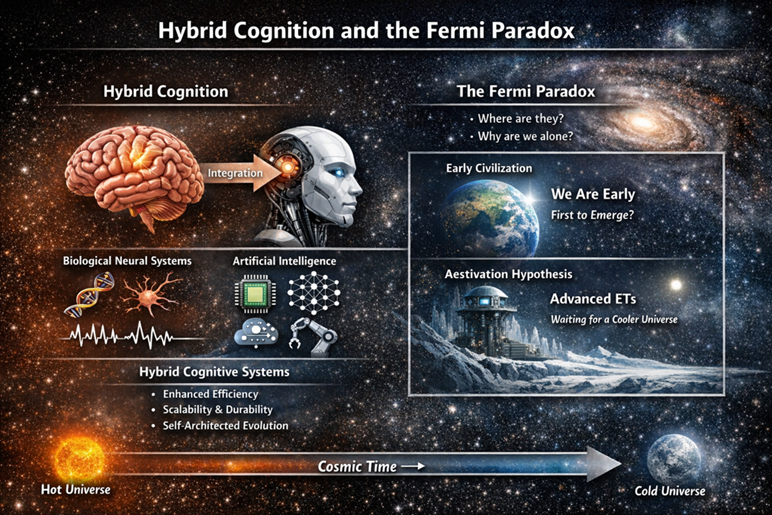
Figure 1: Hybrid Cognition, Cosmic Time, and the Fermi Paradox. Conceptual schematic illustrating the transition from biologically constrained cognition to hybrid cognitive systems that integrate biological neural dynamics with artificial intelligence. The illustration also depicts biological neural substrates and engineered computational architectures converging into distributed, energy-efficient hybrid cognition capable of scalability, durability, and self-directed evolution. This transition within cosmic time and the Fermi Paradox, contrasting the possibility that humanity is an early emergent technological civilization with the aestivation hypothesis, in which advanced hybrid civilizations defer large-scale computation until the universe cools to maximize thermodynamic efficiency. The bottom arrow represents cosmic evolution from a hot, high-gradient universe to a colder, low-gradient future, emphasizing computation, cognition, and intelligence as processes constrained—and shaped—by universal thermodynamic limits.
Physical Limits to Interstellar Contact
The silence that has always filled the night sky has been a source of speculation regarding the presence or absence of intelligent life in the universe. Physicist Richard Feynman has always been keen to note that if one is willing to observe the laws of physics, the silence in the universe is not so mysterious [22]. The universe has hundreds of billions of galaxies and potentially habitable planets, yet the distances between stars are so great that the nearest star, Proxima Centauri, is over four light-years away from Earth. If we are talking in terms of the Milky Way, which is 100,000 light-years in diameter, the probability that two technologically advanced civilizations will physically meet is minuscule [19,23]. The speed of light is a constraint that is a part of the fabric of space and time, according to Einstein’s theory of special relativity [24]. The closer we get to the speed of light, the more energy we must exert to accelerate further, and so even advanced civilizations are still restricted by relativistic limitations that constrain travel and communication over vast distances in space [25]. Propulsion physics also supports the limitations that have been set forth. The equation for propulsion, derived by Konstantin Tsiolkovsky, indicates that the fuel necessary to propel a spacecraft to higher velocities increases exponentially as the velocity of the spacecraft is increased. Even the most advanced propulsion systems, such as those derived from nuclear fusion or antimatter, require vast energy reserves comparable to those of a star [26, 27]. Another set of limitations that impact the probability of interstellar communication is derived from the biological and technological limitations that have been established for life in the universe. The conditions that life has developed in throughout the history of the universe have been limited to those of the planet Earth, where gravity, atmospheric shielding, and magnetic protection combine to create a stable environment in which life can develop. However, exposure to long-term radiation, zero gravity, and isolation pose significant physiological challenges to both human and robotic systems. Even technological systems can fail as a result of exposure to space radiation, micrometeoroids, and thermodynamic breakdown [23]. Another factor that impacts the probability of interstellar communication is the temporal factor that has been established by the development of human civilization. The time that human civilization has been emitting detectable radio signals into space has been approximately 100 years, giving us a communication sphere of 100 light-years in radius. The probability that the development of intelligent life has been synchronized in such a fashion that both civilizations have developed simultaneously in the same time frame, within the same communication sphere, may be extremely low in the vastness of the universe that is 50,000 light-years in radius [20,28].
Cosmic End-States and “Nothingness”
As far as standard ΛCDM models are concerned, the most popular final state of the universe is heat death, or Big Freeze, wherein eventually all structure formation will cease and the universe will come to a state of thermodynamic equilibrium [1]. There are a number of processes that will eventually lead to this final state. One such process is proton decay, which could eventually lead to the complete elimination of baryonic matter on a very long timescale [29]. Black holes will eventually evaporate via Hawking radiation [30]. The final state of the universe will also depend on the nature of dark energy. So far, observations are still consistent with a cosmological constant, but other models are also being explored [31,32]. Other models that have been proposed include a Big Rip scenario if phantom energy or vacuum decay is a reality [33,34]. In any case, as far as thermodynamics are concerned, nothingness or the final state of the universe is not a matter of annihilation but a matter of losing the usable energy gradients.
Intelligence, Computation, and Thermodynamic Limits
Cognition, whether it is biological or artificial, is ultimately a physical process that stores and processes information. According to Landauer's principle, there is a minimum thermodynamic cost of logically irreversible cognitive processes [16]. Quantum computing is a new emerging technology that has the potential to exploit the power of quantum superpositions and entanglements [36-42]. However, it has the problems of scaling and error correction. The possibility of artificial consciousness is still in the realm of hypothesis and will remain there until a theory of consciousness is developed (Figure 1) [43, 44]. As the biological cognitive systems are approaching their energetic and structural limits, a new paradigm of hybrid cognition could emerge, in which biological neural systems are enhanced with artificial intelligence systems, which could potentially provide a more efficient, scalable, and durable system of intelligence compared with the biological systems (Figure 1). However, the most advanced hybrid intelligences will ultimately remain bound by the same laws of thermodynamics that bound the possibilities of interstellar communication and computation. The Fermi paradox, or the lack of extraterrestrial intelligent life, could have a number of other, possibly more fundamental, thermodynamic or evolutionary explanations (Figure 1). One possibility is that we are living too early in the history of the universe, before the emergence of the extremely large-scale intelligences [18]. Another possibility is the aestivation theory, which postulates that advanced civilizations are waiting until the universe cools enough to provide the most efficient computation per unit of energy (Figure 1) [20,21].
Conclusion
Intelligence In The Thermodynamic Story Of Matter
According to classical reasoning, it might last forever in an endless universe by slowing down metabolic and computational processes proportionally to decreasing temperatures [14]. On the other hand, it has been suggested that, in a universe dominated by dark energy, stringent limits exist on available energy within a certain horizon [15]. So, to summarize, we have seen how, from the perspective of the evolution of the universe, the prospects for intelligent life might be considered to fall into three categories: survival through extreme efficiency, survival through new sources of energy, and survival through cosmological changes. Intelligence, from the perspective of the overall thermodynamic history sketched out above, appears to be a transitory but impressive phenomenon in the evolution of matter. The physical laws which permit matter to evolve into intelligent life also seem to be those which will prevent it from communicating over vast distances through space and which might ultimately prevent it from surviving for any great period of time. Intelligent civilizations might be ubiquitous throughout the universe, but forever be out of touch with each other, briefly participating in the thermodynamic evolution of the universe before the gradual dissipation of energy gradients which sustain intelligent phenomena.
Author Contributions
The author is accountable for all aspects of the work.
Ethics Approval and Consent to Participate
Not applicable.
Acknowledgment
None
Funding
This research received no external funding.
Conflict of Interest
The author declares no conflict of interest.
Declaration of AI and AI-assisted Technologies in the Writing Process
During the preparation of this work, the author used ChatGPT 5.2 for organizational information purposes and figure generation. The author reviewed and edited the document as needed and takes full responsibility for its content.
References
- Adams FC, Laughlin G (1997) A dying universe: The long-term fate and evolution of astrophysical objects. Rev Mod Phys 69: 337-372.
- Planck Collaboration (2020) Planck 2018 results. VI. Cosmological parameters. Astron Astrophys 641: A6.
- Bunn EF, Hogg DW (2009) The kinematic origin of the cosmological redshift. Am J Phys 77: 688-694.
- Prigogine I (1977) Self-organization in nonequilibrium systems. Wiley New York.
- Egan CA, Lineweaver CH (2010) A larger estimate of the entropy of the universe. Astrophys J 710: 1825-1834.
- Fields BD (2006) Big bang nucleosynthesis in the new cosmology. Nucl Phys A 777: 208-225.
- Sakharov AD (1967) Violation of CP invariance, C asymmetry, and baryon asymmetry of the universe. JETP Lett 5: 24-27.
- Particle Data Group (2024) Review of particle physics. Prog Theor Exp Phys.
- Madau P, Dickinson M (2014) Cosmic star-formation history. Annu Rev Astron Astrophys 52: 415-486.
- Burbidge EM, Burbidge GR, Fowler WA, Hoyle F (1957) Synthesis of the elements in stars. Rev Mod Phys 29: 547-650.
- England JL (2015) Dissipative adaptation in driven self-assembly. Nat Nanotechnol 10: 919-923.
- Loeb A, Batista R, Sloan D (2016) Relative likelihood for life as a function of cosmic time. JCAP 08: 040.
- Sorini D, Peacock JA, Lombriser L (2024) The impact of the cosmological constant on past and future star formation. arXiv:2411.07301.
- Dyson FJ (1979) Time without end: Physics and biology in an open universe. Rev Mod Phys 51: 447-460.
- Krauss LM, Starkman GD (2000) Life, the universe, and nothing. Astrophys J 531: 22-30.
- Landauer R (1961) Irreversibility and heat generation in computing. IBM J Res Dev 5: 183-191.
- Lloyd S (2000) Ultimate physical limits to computation. Nature 406: 1047-1054.
- Hanson R, Martin A, McCarter J, Paulson T (2021) If loud aliens explain why we are so early, can we be confident we are alone? Astrophys J 922: L15.
- Wright JT (2020) Exoplanets and SETI. Annu Rev Astron Astrophys 58: 617-651.
- Sandberg A, Drexler E, Ord T (2018) Dissolving the Fermi paradox. arXiv:1806.02404.
- Sandberg A, Armstrong S, Ćirković M (2017) The aestivation hypothesis for resolving Fermi’s paradox. Oxford University Repository.
- Shavit J (2026) Interstellar travel is impossible and aliens haven’t visited Earth. The Brighter Side of News.
- Lingam M, Loeb A (2021) Life in the Cosmos: From Biosignatures to Technosignatures. Harvard University Press.
- Einstein A (1905) On the electrodynamics of moving bodies. Ann Phys 17: 891-921.
- Thorne KS (1994) Black Holes and Time Warps: Einstein’s Outrageous Legacy. W. W. Norton, New York.
- Forward RL (1984) Roundtrip interstellar travel using laser-pushed lightsails. J Spacecraft Rockets 21: 187-195.
- Lubin P (2016) A roadmap to interstellar flight. J Brit Interplanet Soc 69: 40-72.
- Wright JT, Kanodia S, Lubar E (2018) How much SETI has been done? Astron J 156: 260.
- Takenaka A (2020) Search for proton decay via p → e⁺π⁰ with Super-Kamiokande. Phys Rev D 102: 112011.
- Hawking SW (1975) Particle creation by black holes. Commun Math Phys 43: 199-220.
- Kirshner RP (1999) Supernovae, an accelerating universe, and the cosmological constant. Proc Natl Acad Sci USA 96: 4224-4227.
- DESI Collaboration (2024) Cosmological constraints from baryon acoustic oscillations. arXiv: 2404.03002.
- Caldwell RR, Kamionkowski M, Weinberg NN (2003) Phantom energy and cosmic doomsday. Phys Rev Lett 91: 071301.
- Coleman S, De Luccia F (1980) Gravitational effects on and of vacuum decay. Phys Rev D 21: 3305-3315.
- Bekenstein JD (1981) Universal upper bound on the entropy-to-energy ratio. Phys Rev D 23: 287-298.
- National Academies of Sciences, Engineering, and Medicine (2019) Quantum Computing: Progress and Prospects.
- Stefano GB (2023) Artificial Intelligence as a Tool for the Diagnosis and Treatment of Neurodegenerative Diseases. Brain Sci 13: 938.
- Stefano GB (2024) Quantum Computing and the Future of Neurodegeneration and Mental Health Research. Brain Sci 14: 93.
- Stefano GB (2024) Quantum Computing and Artificial Intelligence: Disruptive Technology with Potential Applications in Surgical Practice J Surg 9.
- Stefano GB (2026) Delivering precision: Medical molecular robotics and the next phase of personalized medicine. J Artif Intell Robot 3: 1031.
- Stefano GB (2026) Cooperative AI and Human-Centered Systems for Space Exploration and Translational Medicine Including Surgery. J Surg 11: 11568.
- Tononi G, Boly M, Massimini M, Koch C (2016) Integrated information theory: from consciousness to its physical substrate. Nat Rev Neurosci 17: 450-461.
- Chella A (2023) Artificial consciousness: The missing ingredient for ethical AI? Front Robot AI 10:1270460.
- Farisco M, Evers K, Changeux JP (2024) Is artificial consciousness achievable? Neural Networks 180:106714.
© by the Authors & Gavin Publishers. This is an Open Access Journal Article Published Under Attribution-Share Alike CC BY-SA: Creative Commons Attribution-Share Alike 4.0 International License. Read More About Open Access Policy.