 Opinion
 Cooperative AI and Human-Centered Systems for Space Exploration and Translational Medicine Including Surgery
by George B. Stefano1,2*
¹Department of Psychiatry, First Faculty of Medicine, Charles University and General University Hospital, Prague, Czech Republic
²Mind-Cell LLC, 841 E. Fort Ave, B-411, Baltimore, MD 21230, USA
*Corresponding Author: George B. Stefano, Mind-Cell LLC, 841 E. Fort Ave, B-411, Baltimore, MD 21230, USA
Received Date: 10 February 2026
Accepted Date: 17 February 2026
Published Date: 19 February 2026
Citation: Stefano GB (2026) Cooperative AI and Human-Centered Systems for Space Exploration and Translational Medicine Including Surgery. J Surg 11: 11568 DOI: https://doi.org/10.29011/2575-9760.011568
Abstract
Space exploration has progressed beyond a domain in which technical, biological, or ethical knowledge from isolated sectors can be independently applied. Contemporary missions require coordinated engagement of government space agencies, academic research institutions, and commercial enterprises. This cooperative triad is increasingly necessary as mission duration, autonomy, and biological risk expand. Artificial intelligence, quantum computing, and structured human oversight now function as integrated operational elements rather than adjunct tools. Importantly, the same cooperative framework that enables long-duration space exploration has historically driven major advances in medicine, including neurosurgery, neurorehabilitation, prosthetics, precision oncology, and aging research through space robotics, microgravity biology, and autonomous systems. Space has therefore evolved from a purely exploratory frontier into a translational accelerator for surgery and medicine. The effectiveness of this model depends on early alignment of legal frameworks, intellectual property rights, and governance structures, particularly at the interface between government and commercial sectors.
Keywords: Artificial Intelligence; Governance Frameworks; Human–Machine Systems; Microgravity Biology; Quantum Computing; Space Medicine; Space Robotics; Translational Surgery
Cooperative Human–Machine Co-Agency as the New Operational Baseline
Space exploration has evolved into a fundamentally computer-mediated form that calls for close collaboration between government mission authorities, university research centers, and commercial technology developers. As mission complexity increases to include autonomous navigation, multi-agent coordination, fault detection, and resource allocation in uncertain environments, cognitive demands outgrow human capabilities. Artificial intelligence agents are increasingly employed to perform high-dimensional optimization and control, while humans are left with intent, context, and ethics judgment responsibilities [1,2]. This distribution of agency is intrinsically tied to institutional interdependence. Government missions provide mission authority, university centers provide foundational research and validation, and commercial developers provide hardware and software platforms. In deep space, especially in Mars-class missions, communication latency makes real-time terrestrial intervention impossible, making AI-based autonomy a necessity in space exploration operations [3]. In this context, humans are decision authorities who evaluate AI-provided choices and are accountable for irreversible decisions regarding biological life, especially in isolation, circadian disruption, and neurocognitive stress conditions [2].
Autonomy, Governance, and Legal Alignment in Hybrid Crews
In the context of deep space exploration, future missions are increasingly characterized by hybrid crews that include human operators, humanoid robots, and mission-specific autonomous systems. Thus, with the increasing role of autonomy in such deep space exploration missions, the issue of governance, liability, and accountability has emerged as a central concern, particularly when such autonomy is based on the use of commercial technologies within government-led deep space exploration missions. Indeed, formal governance structures highlight transparency, explainability, safety, accountability, and human override as key prerequisites for mission-critical AI systems [4]. These issues must be contractually agreed upon at the outset of any collaborative endeavor to address algorithm ownership, liability in the event of system failure, and any subsequent medical or business application of the developed autonomy technologies. From a practical perspective, AI plays a key role in collision avoidance and orbital risk management in a highly congested orbital environment. Digital twins of the system, which are highly accurate virtual system replicas synchronized with real-time telemetry, are increasingly used to assess decision-making strategies under conditions of uncertainty. These technologies were originally developed within government-university research collaborations but are operationalized through a commercial partner (Figure 1).
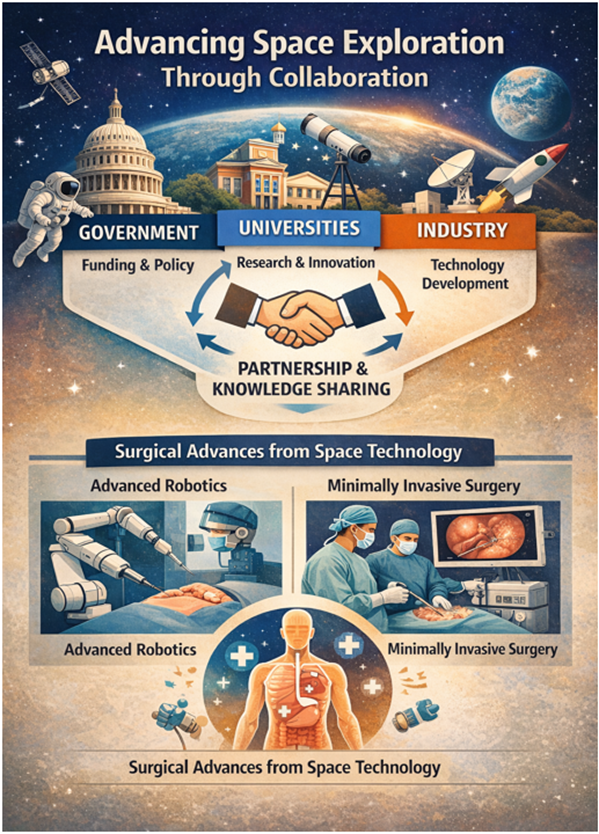
Figure 1: Conceptual schematic illustrating the tri-sector cooperation required for contemporary space exploration. Government agencies provide mission oversight, regulatory frameworks, and sustained funding; universities contribute fundamental research, training, and innovation; and commercial partners translate discoveries into scalable technologies. The bidirectional exchange among these sectors enables advanced space systems while simultaneously accelerating human medical translation, with surgical robotics and minimally invasive procedures shown as representative examples of downstream clinical impact.
Quantum Computing within a Cooperative Innovation Pipeline
Quantum computing is considered an emerging technology; however, its relevance to space robotics is founded upon its potential to aid in solving combinatorial optimization problems that might be encountered in space robots. The potential applications of quantum computing in space robots include swarm robot control in dynamically constrained spaces [5]. Currently, research in quantum computing is primarily conducted in research institutions and national laboratories. Therefore, quantum computing should be considered an emerging technology that is dependent upon continued cooperation between public research institutions and private innovators.
Translational Medicine Enabled by Space Robotics Partnerships
The technologies that have emerged from the projects undertaken under the space robotics initiative have enabled significant advancements in precision medicine. One of the most notable examples of such an initiative is neuroArm, the first MRI-compatible robotic system for neurosurgery. neuroArm was developed from Canadian space robotics technology. neuroArm allows biopsies and tumor removals with submillimeter precision within a magnetic resonance imaging environment. It also addresses issues of tremor during neurosurgical procedures [6, 7]. Robot-assisted visualization technologies, such as advanced digital microscopy systems, have also improved visualization during neurosurgical and spinal procedures. At the same time, research on tactile sensing technology originally intended for humanoid space robotics has led to the design of surgical instruments that can identify tissue stiffness and elasticity. This allows for improved precision during biopsies while minimizing damage to the affected tissues. One of the most documented examples of the application of robotics technologies in ophthalmology is that of LASIK surgery. Modern LASIK surgery utilizes high-frequency eye-tracking technologies originally developed from the laser radar system intended for autonomous spacecraft rendezvous and docking. This allows for real-time compensation of involuntary eye movements during corneal reshaping [9-11].
Neurorehabilitation, Prosthetics, and Cooperative Human–Robot Interface
The space-qualified actuators and motors designed for space applications have been repurposed for advanced prosthetics, allowing for quieter operation, energy efficiency, and more physiological patterns of gait [12,13]. Robotic exoskeletons designed to assist astronaut locomotion in microgravity environments have become an integral component of neuro-rehabilitation protocols for stroke and spinal cord injury patients [14,15]. Clinical studies have demonstrated the efficacy of repetitive weight-bearing robotic gait training in improving sensorimotor integration and the development of activity-dependent neuroplasticity [16,17]. This represents an example of the cooperative development pipeline in which space technologies have been repurposed as therapeutic interventions, as opposed to assistive technologies [18,19]. Physiological monitoring technologies designed for astronaut health monitoring have also been repurposed as wearable biosensors for the continuous monitoring of stress, metabolic imbalances, and diseases [2].
Microgravity Research as a Shared Experimental Infrastructure
Microgravity is a unique and consistent research environment that cannot be adequately simulated on Earth and is, therefore, considered a common scientific resource to be shared by government, academia, and industry. It affects various biological phenomena, including cellular mechanotransduction, cytoskeleton arrangement, mitochondrial metabolism, and protein aggregation, thereby accelerating biological aging and degeneration processes [20,21]. In the central nervous system, microgravity is known to affect neuronal morphology, synaptic signaling, intracellular calcium handling, and mitochondrial function. These phenomena provide a robust model to study neurodegenerative and neuroplastic processes [22]. The study of protein aggregation in microgravity helps in better structural characterization of amyloid fibrils that cause Alzheimer's and Parkinson's diseases [23]. The microgravity environment causes rapid musculoskeletal degeneration that is similar to age-related degeneration in both muscles and bones. These phenomena were demonstrated in “Mighty Mice,” which were genetically deficient in myostatin and directly relate to aging and degeneration-related diseases [24].
Brain Organoids, Stem Cells, and Cooperative Biomedical Platforms
It is surmised that microgravity enhances three-dimensional cultures of neurons, which are more similar to the structure of the human brain. Brain organoids grown in space, developed through collaboration between space agencies, universities, and biomedical companies, are powerful tools in neurodevelopment, neurodegenerative, and drug toxicity studies. Neural stem cells grown in microgravity have greater pluripotency and proliferative potential, which are important in regenerative medicine for stroke and traumatic brain injury.
Commercial–University–Government Partnerships as the Operational Core
The advent of commercial spaceflight has transformed low-Earth orbit into a sustained biomedical research environment supported by formal partnerships among private space companies, universities, hospitals, and research foundations. Examples include cancer-biology investigations using three-dimensional tumor organoids [25,26], implantable drug-delivery systems for remote medicine [27], autonomous orbital pharmaceutical manufacturing platforms [28], and neurodegenerative disease research using space-grown stem cells [29]. Private astronaut missions have also incorporated AI-enabled neurophysiological monitoring to study intracranial pressure regulation [30]. These initiatives underscore the necessity of early governance alignment when biomedical research carries both public-health and commercial implications.
Conclusion: Cooperative Space Systems as a Blueprint for Hybrid Medicine
Space exploration exposes the biological and cognitive limits of humans, necessitating AI-assisted autonomy, emerging quantum computation, and structured human oversight. None of these elements can function effectively in isolation. Sustained collaboration among government agencies, academic institutions, and commercial enterprises has therefore become the structural prerequisite for both deep-space exploration and translational medicine. This cooperative architecture has transformed space from an operational frontier into a catalyst for surgical and medical innovation, offering a scalable blueprint for hybrid human–machine medicine on Earth.
References
- Stefano GB, Kream RM (2017) Artificial Intelligence, DNA Mimicry, and Human Health. Med Sci Monit 23: 3923-3924.
- Stefano GB, Fernandez EA (2017) Biosensors: Enhancing the Natural Ability to Sense and Their Dependence on Bioinformatics. Med Sci Monit 23: 3168-3169.
- Clement G, Bukley A (2007) Artificial Gravity. Springer; New York.
- McLarney E (2021) Framework for the Ethical Use of Artificial Intelligence. NASA Headquarters Policy Document; Washington, DC.
- Chella A, Cesta A, Finzi A, Pirrone R (2013) Symbolic and deliberative planning for autonomous robotic systems. Robotics Auton Syst 61: 1195-1208.
- Sutherland GR, Latour I, Greer AD (2008) An MRI-compatible robot for neurosurgery. J Neurosurg 108: 200-206.
- Sutherland GR, Wolfsberger S, Lama S (2011) Functional assessment of neuroArm. Neurosurgery 68: 151-158.
- Muhammad S, Lehecka M, Niemelä M, Hernesniemi J (2019) Advanced digital microscopy in neurosurgery. World Neurosurg 125: e1046-e1054.
- Taylor NM (2000) Accuracy of eye-tracking systems for laser refractive surgery. J Refract Surg 16: S643-S646.
- Feng Z, Yue Y, Dai D, Yuan L, Nan Y (2020) Laser radar systems for deep-space rendezvous and docking. Appl Opt 59: 10565-10573.
- Wertz JR, Everett DF, Puschell JJ (2011) Space Mission Engineering: The New SMAD. Microcosm Press; Hawthorne, CA.
- Dollar AM, Herr H (2008) Lower extremity exoskeletons and active orthoses. IEEE Trans Robot 24: 144-158.
- Herr H, Grabowski AM (2012) Bionic ankle–foot prosthesis normalizes walking gait. Proc Natl Acad Sci USA 109: 17093-17098.
- Kazerooni H, Steger R, Huang L (2006) Hybrid control of the Berkeley lower extremity exoskeleton. Int J Robot Res 25: 561-573.
- Pons JL (2008) Wearable Robots: Biomechatronic Exoskeletons. Wiley; Chichester.
- Sale P, Franceschini M, Waldner A, Hesse S (2012) Robot-assisted gait therapy. Eur J Phys Rehabil Med 48: 111-121.
- Mehrholz J, Thomas S, Werner C (2017) Electromechanical-assisted walking after stroke. Cochrane Database Syst Rev 10: CD006185.
- Reinkensmeyer DJ, Boninger ML (2012) Technologies for enhancing movement training. J Neuroeng Rehabil 9: 17.
- National Aeronautics and Space Administration (2018) NASA Spinoff 2018: Robotic Exoskeletons and Prosthetics. Washington, DC.
- Pietsch J (2017) Cellular responses to microgravity. FASEB J 31: 4171-4185.
- Grimm D (2018) Microgravity and bone metabolism. npj Microgravity 4: 12.
- Grimm D (2018) Microgravity effects on neuronal function. npj Microgravity 4: 12.
- Yagi-Utsumi M (2025) Microgravity-assisted amyloid-β fibril formation. ACS Chem Neurosci 16: 1123-1134.
- Lee SJ (2020) Myostatin inhibition protects against muscle loss in microgravity. Proc Natl Acad Sci USA 117: 23942-23951.
- Axiom Space (2023) Cancer in Low-Earth Orbit Research Program. Technical Brief.
- UC San Diego Sanford Stem Cell Institute (2023) Cancer Stem Cell Research in Microgravity. Institutional Summary.
- Houston Methodist Research Institute (2021) Implantable Drug Delivery Systems for Spaceflight. White Paper; Houston, TX.
- Varda Space Industries (2023) Microgravity-Enabled Pharmaceutical Manufacturing. Technical Overview.
- National Stem Cell Foundation (2022) Neural Stem Cell Research on the International Space Station. Research Report.
- Marshall-Goebel K (2024) Intracranial and ocular changes during commercial spaceflight. npj Microgravity 10: 3.
© by the Authors & Gavin Publishers. This is an Open Access Journal Article Published Under Attribution-Share Alike CC BY-SA: Creative Commons Attribution-Share Alike 4.0 International License. Read More About Open Access Policy.