 Opinion
 Energy Evolution to Matter to Cognition: Thermodynamic Dependency, Conformational Matching, and the Emergence of Intelligent Systems
by George B. Stefano*
Mind-Cell LLC, Baltimore, MD 21230, USA
*Corresponding Author: George B. Stefano, Mind-Cell LLC, Baltimore, MD 21230, USA
Received Date: 28 March 2026
Accepted Date: 30 March 2026
Published Date: 01 April 2026
Citation: Stefano GB (2026) Energy Evolution to Matter to Cognition: Thermodynamic Dependency, Conformational Matching, and the Emergence of Intelligent Systems. J Surg 11: 11600 DOI: https://doi.org/10.29011/2575-9760.011600
Abstract
The thermodynamic evolution of the universe is characterized by the gradual dissipation of large-scale energy gradients while simultaneously enabling the emergence of chemical complexity, life, and cognition. This apparent paradox reflects the role of localized, work-extracting disequilibria that sustain ordered structures even as the universe trends toward equilibrium. Within these transient energetic niches, matter organizes into increasingly complex systems, culminating in biological and cognitive phenomena. The widespread presence of organic precursors suggests that prebiotic chemistry is a natural consequence of thermodynamic conditions wherever suitable gradients persist. Across scales, a unifying principle emerges in which energy flow and information processing are coupled through conserved molecular interactions, including conformational matching. As cosmic evolution proceeds—marked by declining star formation since cosmic noon and continued cooling—complex systems appear increasingly dependent on energetic efficiency rather than abundance. In this context, cognition and computation may represent advanced thermodynamic strategies for optimizing residual energy gradients. Intelligence thus emerges as a transient yet profound phase in the evolutionary trajectory of matter.
Keywords: Cognition; Conformational Matching; Cosmic Evolution; Energy Gradients; Thermodynamics; Prebiotic Chemistry
Abbreviations: DNA: Deoxyribonucleic; RNA: Ribonucleic acid
Introduction
The evolution of the universe can be understood through thermodynamic principles governing energy distribution and transformation. Following cosmic expansion, matter and energy became dispersed across spacetime, initiating a long-term trajectory toward equilibrium [1,2]. Despite this global trend, localized regions of disequilibrium persist and provide the conditions necessary for the emergence of structured complexity. A central concept in this process is that of work-extracting energy gradients, defined as physical disequilibria capable of performing work. These include thermal, chemical, redox, gravitational, and radiative gradients. Such gradients sustain ordered systems consistent with dissipative structures described by Prigogine [3]. Recent developments in statistical physics indicate that systems far from equilibrium evolve toward configurations that enhance energy dissipation, thereby promoting self-organization and replication [4]. Within this framework, biological systems emerge as natural consequences of thermodynamic processes. The heterogeneous environments generated by stellar nucleosynthesis, gravitational evolution, and planetary formation create energetic landscapes that support increasing complexity [5-7]. Life and cognition can thus be interpreted as higher-order dissipative structures, although constrained to localized domains by thermodynamic limits [7,8] (Figure 1).
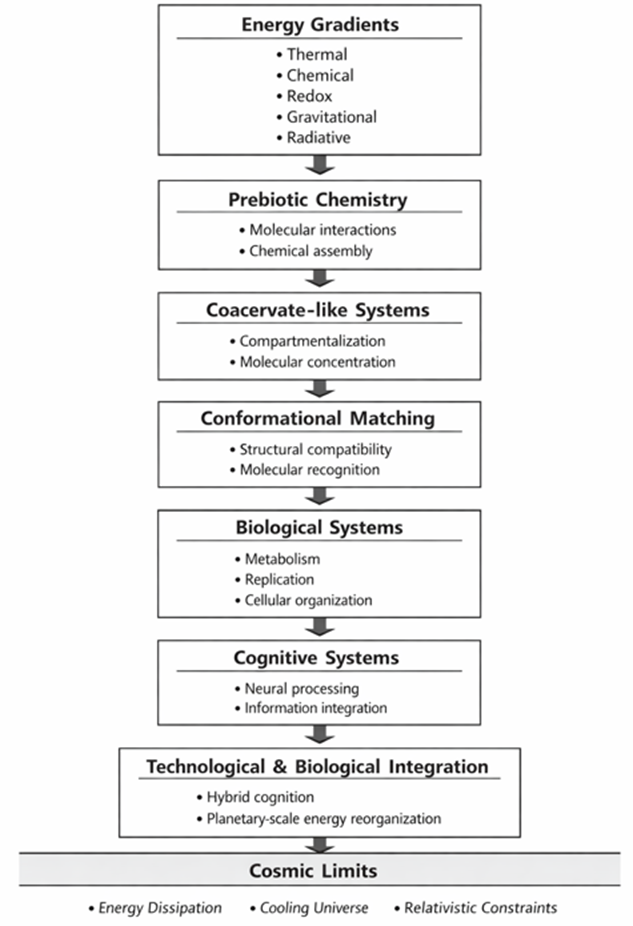
Figure 1: Thermodynamic progression from energy gradients to cognition and technological systems.
This schematic illustrates the hierarchical emergence of complexity driven by work-extracting energy gradients. Initial physicochemical gradients, including thermal, chemical, redox, gravitational, and radiative sources, enable prebiotic chemical interactions and molecular assembly. Coacervate-like systems provide localized environments for molecular concentration and stabilization, facilitating conformational matching as a fundamental mechanism of molecular recognition. These processes support the emergence of biological systems characterized by metabolism, replication, and cellular organization. Increasing complexity gives rise to cognitive systems capable of information processing and adaptive response. At higher levels, integration of biological cognition with technological systems enables large-scale reorganization of energy flows. Across all stages, system persistence is constrained by cosmic limits, including progressive energy dissipation, universal cooling, and relativistic boundaries. This framework positions cognition and technological intelligence as thermodynamically grounded extensions of matter evolution.
Energy Gradients and Chemical Complexity
The chemical evolution of the universe began with light element formation followed by stellar nucleosynthesis producing heavier elements required for complex chemistry [5]. As the universe cooled, these elements combined into molecules, enabling increasingly sophisticated chemical interactions. Cosmochemical studies demonstrate that precursors of life are widespread. Analyses of asteroid Bennu samples have revealed ammonia, organic compounds, and prebiotic molecules, supporting the view that chemical complexity emerges naturally under suitable thermodynamic conditions [9,10]. As star formation declines following cosmic noon, total energy throughput decreases [6,11]. However, lower-energy environments may favor molecular stability, supporting the persistence and evolution of complex chemical systems [6,7].
Prebiotic Chemistry and Conformational Matching
The transition from chemistry to biology likely occurred in environments where energy gradients facilitated molecular concentration and interaction. Coacervate-like systems provide plausible microenvironments for stabilizing primitive biochemical networks [12]. Within these systems, conformational matching, structural compatibility between molecules, enables selective interaction and molecular recognition [13]. This principle represents a thermodynamically favorable mechanism through which stable biochemical configurations emerge. Such interactions provide a bridge from random chemistry to organized biological systems capable of replication and information processing [12,13].
Biological Continuity and Molecular Interaction
\Biological evolution reflects a continuum of molecular interaction and energy transfer rather than isolated events. Processes such as horizontal gene transfer, viral integration, and endosymbiosis demonstrate the interconnected nature of living systems [12]. This continuity extends from molecular to organismal scales and is unified by conserved structural and energetic principles. Conformational matching operates across these levels, enabling communication and functional integration [13,14]. In neural systems, these same principles underpin signaling specificity and information processing, linking molecular interactions to cognition.
Cognition, Cosmic Cooling and Intelligent Systems
Observational cosmology indicates that star formation peaked approximately 8–12 billion years ago and has since declined [6,9], while the universe continues to cool [2]. These changes reflect a reduction in energy availability across cosmic time. Under such conditions, the persistence of complex systems depends increasingly on efficiency rather than abundance. Thermodynamic gradients remain central drivers of organization, but systems capable of optimizing energy utilization are favored. At the planetary scale, intelligent civilizations reorganize energy flows across biospheres [8]. Cognition and computation may therefore represent advanced thermodynamic strategies, “cold cognition”, optimized for low-energy environments [7]. However, relativistic limits constrain communication and travel across cosmic distances [15], and the energetic requirements for interstellar exploration remain substantial [16,17]. Combined with evolutionary asynchrony, these factors likely result in the isolation of intelligent systems [18]. Thus, the absence of detectable extraterrestrial intelligence may reflect thermodynamic and physical constraints rather than true absence [7,19].
Conclusion
The thermodynamic evolution of the universe provides a coherent framework for understanding the emergence of chemical complexity, life, and cognition. At the moment of cosmic inflation, energy dispersed with extraordinary rapidity, and as the universe expanded and cooled, this energy progressively condensed into structure—first into fundamental particles, then into atoms, and ultimately into the elements that compose matter. This transformation was not random; it was governed by underlying energy gradients that directed how particles formed, interacted, and stabilized. As global energy gradients declined over cosmic time, local gradients persisted, enabling the emergence of increasingly complex systems with the capacity to communicate, replicate, and adapt. In parallel, these earliest processes established a fundamental principle of organization—compatibility, or “fitting”—where stability depended not only on energetic favorability but also on how well structures aligned, an early manifestation of conformational matching. From this foundation, increasing complexity unfolded in a continuous and cumulative manner. Atoms combined into molecules, molecules into more intricate chemical systems, and ultimately into the precursors of biological organization. Each stage built upon prior structures, constrained and enabled by the same energy gradients and structural compatibilities established in the earliest moments of the universe. The principle of conformational matching thus explains how consistent molecular structures facilitate communication among biochemical systems, driving progressively complex biological organization. Prebiotic systems in coacervate-like microenvironments may have provided the initial setting in which primitive biochemical networks were stabilized [12]. In this sense, biological evolution represents a profound energetic and informational continuity rooted in shared chemical origins and conserved interaction dynamics. As cosmic energy gradients continue to diminish, the persistence of complex systems increasingly depends on efficiency rather than abundance. Biological systems exploit remaining gradients, adapting dynamically to fluctuations in energy availability while preserving the principle of structural “fit.” Intelligence and technology may therefore be understood as transient yet profound expressions of matter’s capacity to organize and process information under thermodynamic constraints. Within this framework, cognition emerges not as an isolated phenomenon, but as a phase in the broader evolution of matter—one in which the universe, through organized complexity, attains the capacity to reflect upon itself [7].
Author Contributions: The author is accountable for all aspects of the work.
Ethics Approval and Consent to Participate: Not applicable.
Acknowledgment: Not applicable.
Funding: This research received no external funding.
Conflict of Interest: The author declares no conflicts of interest.
Declaration of AI and AI-assisted Technology in the Writing Process: During the preparation of this work, the author used ChatGPT 5.2 for organizational information and copyediting purposes and original figure generation. The author reviewed and edited the document and takes full responsibility for its content.
References
- Adams FC, Laughlin G (1997) Rev Mod Phys 69: 337-372.
- Planck Collaboration (2020) Astron Astrophys 641: A6.
- Prigogine I (2013) From Being to Becoming: Time and Complexity in the Physical Sciences. Freeman; 1978.
- England JL. J Chem Phys 139: 121923.
- Burbidge EM, Burbidge GR, Fowler WA, Hoyle F (1957) Rev Mod Phys 29: 547-650.
- Madau P, Dickinson M (2014) Annu Rev Astron Astrophys 52: 415-486.
- Stefano GB (2026) J Surg 11: 11580.
- Frank A, Grinspoon D, Walker S (2022) Int J Astrobiol 21: 47-61.
- Förster Schreiber NM, Wuyts S (2020) Annu Rev Astron Astrophys 58: 661-725.
- McCoy TJ, Lauretta DS, Alexander CMO (2025) Nature 637: 1072-1077.
- Stefano GB, Kream RM (2025) Primordial Biochemicals Within Coacervate-Like Droplets and the Origins of Life. Viruses 17: 146.
- Glavin DP, Dworkin JP, Alexander CMO (2025) Abundant ammonia and nitrogen-rich soluble organic matter in samples from asteroid (101955) Bennu. Nat Astron 9: 199-210.
- Stefano GB (1989) Med Hypotheses 30: 107-112.
- Stefano GB (2025) Adaptability Beyond Darwin: Microbial Evolution, Mitochondria, and the Thermodynamic Frontiers of Survival Front Biosci (Landmark Ed) 30: 45962.
- Einstein A (1905) On The Electrodynamics Of Moving BodiesAnn Phys 17: 891-921.
- Wright JT (2020) Annu Rev Astron Astrophys 58: 617-651.
- Lingam M, Loeb A (2021) Life in the Cosmos: From Biosignatures to Technosignatures. Harvard Univ Press
- Kipping D, Frank A, Scharf C (2020) Int J Astrobiol 19: 448-456.
- Wright JT, Kanodia S, Lubar E (2018) How Much SETI Has Been Done? Finding Needles in the n-dimensional Cosmic Haystack Astron J 156: 260.
© by the Authors & Gavin Publishers. This is an Open Access Journal Article Published Under Attribution-Share Alike CC BY-SA: Creative Commons Attribution-Share Alike 4.0 International License. Read More About Open Access Policy.