 Review Article
 Medieval Origins of Negative Pressure Wound Therapy: Ibn Al Quff’s 13th-Century Approach to Surgical Drainage
by Tareq M. R. AL-Jaberi*
Department of Surgery, Jordan University of Science and Technology, Irbid- Jordan
*Corresponding author: Tareq M. R. AL-Jaberi, Department of Surgery, Jordan University of Science and Technology, Irbid- Jordan
Received Date: 06 September 2025
Accepted Date: 15 September 2025
Published Date: 17 September 2025
Citation: AL-Jaberi TMR (2025) Medieval Origins 0f Negative Pressure Wound Therapy: Ibn Al Quff’s 13th-Century Approach to Surgical Drainage. J Surg 10: 11439 https://doi.org/10.29011/2575-9760.011439
Abstract
Negative Pressure Wound Therapy (NPWT) is commonly regarded as a late 20th-century innovation in surgical care. However, historical evidence reveals that the core principle of using suction to evacuate harmful matter from wounds was documented centuries earlier. This article reexamines the origins of NPWT by analyzing the 13th-century surgical treatise Al-ʿUmda fī Ṣināʿat al-Jirāḥa by Ibn al Quff, a prominent medieval Arab surgeon. Drawing on manuscript MS 23409 (Qatar National Library) (originally from the British National Library), we identify a previously overlooked passage describing the therapeutic use of cupping directly over purulent ulcers to extract pus via suction. This represents a clear, early application of negative pressure for wound drainage, distinct from the better-known use of cupping for bloodletting or toxin removal.
Keywords: Arabic Medical Manuscripts; Historical Wound Management; Ibn al Quff, Jordan, Medieval Islamic Medicine; Negative Pressure Wound Therapy (NPWT); Surgical History
Introduction
Negative Pressure Wound Therapy (NPWT), although formalized in the late 20th century, is based on the principle of applying suction to remove infectious material and promote healing [1]. This paper traces this principle back to the medieval Arab Islamic world, highlighting the surgical contributions of Ibn al Quff, a 13th-century military physician and author of one of the most comprehensive Arabic surgical manuals, AlʿUmda fī Ṣināʿat al-Jirāḥa [2].
Historical Context and Ibn al Quff’s Contribution
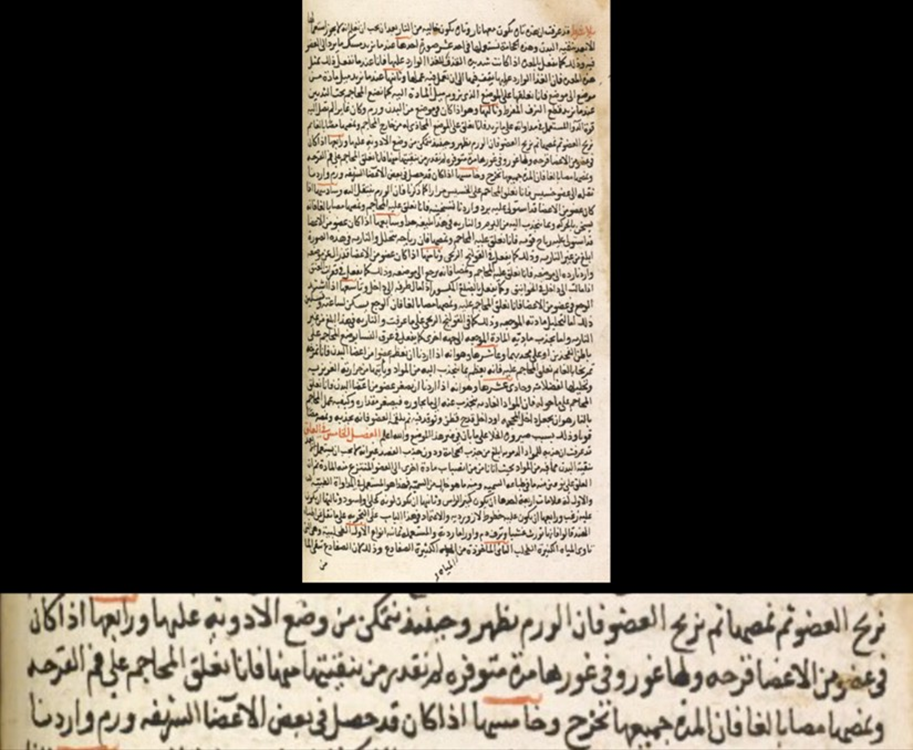
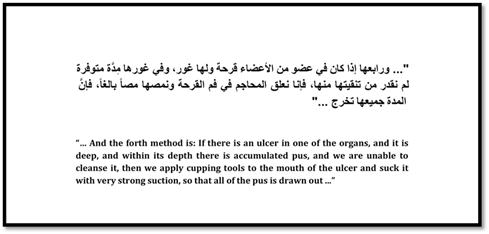
Ibn al Quff (1233–1286 CE), full name Amīn al Dawlah Abū al Faraj Muwaffaq al Dīn Ibn Ya‘qūb Ibn Isḥāq Ibn al Quff al Mālikī al Karakī, was a distinguished 13th century Arab physician and surgeon. Born in Karak (modern day Jordan), he served in Ajloun (Jordan) and Damascus (Syria), practicing primarily as a surgeon during an era marked by significant warfare and regional instability. His appointment as a military surgeon deeply shaped his expertise in trauma surgery and battlefield medicine. He made substantial contributions across anatomy, surgery, and medical ethics [3-6]. His most influential work, Al ʿUmda fī Ṣināʿat al Jirāḥa (The Mainstay in the Craft of Surgery), remains one of the most complete surgical treatises from the medieval Islamic world. This encyclopedic text comprises 20 maqālāt (sections) subdivided into detailed chapters, combining inherited Greco Roman medical knowledge with empirical insights and contributions born from the Arab Islamic medical tradition [2]. A particularly important segment is Maqāla 10, titled “General Principles Necessary for Understanding Particular Therapeutic Interventions”, in which Ibn al Quff lays out the theoretical foundations underpinning surgical decision making. In chapter four of this section, he extends the therapeutic use of cupping beyond customary bloodletting practices and venom suction. His formulations exhibit critical engagement with earlier authorities and a clear drive towards empirical refinement [2].Of particular note is his innovative method for treating deep seated suppurating ulcers. He instructs applying a cupping vessel directly to the ulcer’s orifice and invoking vigorous suction to extract purulent material, an approach aimed at cleansing infection in a manner remarkably advanced for the period [2].
Primary Source Evidence
The source for this technique is MS 23409, preserved in the Qatar National Library and recently digitized (originally from the British National Library) [2].
Discussion and Clinical Implications
Negative pressure wound therapy (NPWT), now a cornerstone of modern wound management, has seen rapid advancements since its formal development in the early 1990s [1]. However, the foundational concept behind NPWT (applying suction to evacuate harmful substances from wounds) has deep historical roots, for instance, oral suction was commonly used to extract toxins following animal bites during the Roman era, a practice echoed in other cultures as well [1,7]. Cupping, another technique involving negative pressure, has been similarly documented in historical sources, predominantly in the context of treating poisoned wounds [1,7]. Contemporary interest in its use for traumatic injuries, such as those incurred in warfare, represents a modern reinterpretation of this ancient practice [1]. Our historical review also identifies a curious gap in the narrative between the Greco-Roman period and the 19th century, during which the prolific contributions of the medieval Arab-Islamic medical tradition appear largely overlooked. Even in Harris’s 1838 lecture (an engaging 19th-century source on wound care) [7], the application of cupping is discussed exclusively for poisonous wounds, with reference to Hippocratic teachings but without first-hand clinical validation. In this commentary, we draw attention to a little-known but significant medieval source that expands the scope of historical negative pressure applications. Specifically, we highlight a 13th-century surgical treatise (Al ʿUmda fī Ṣināʿat al Jirāḥa = The Mainstay in the Craft of Surgery), authored by a military physician-Ibn al Quff- born in present-day Jordan, which describes the use of cupping not only for poisoned wounds but also for infected wounds requiring deep pus evacuation as clearly stated in section 10, chapter 4. Notably, he describes its application to deep-seated, purulent ulcers, instructing that cupping vessels be placed directly over the wound to induce strong suction for the evacuation of pus:“If there is an ulcer in one of the organs, and it has depth, and in that depth, there is accumulated pus we are unable to reach, then we place the cupping vessels over the mouth of the ulcer and perform vigorous suction, so that all the pus will be drawn out.” [1] This passage reflects a critical evolution in the function of cupping, from humoral regulation to mechanical debridement of infected wounds. Such use aligns not with bloodletting or toxin extraction alone, but with an early surgical logic of drainage by negative pressure. This account offers rare documentation of cupping as a therapeutic intervention for purulent infections, broadening our understanding of pre-modern surgical techniques and their alignment with principles now formalized in NPWT.
Summary
This historical analysis reveals that core elements of NPWT (namely mechanical drainage of infected wounds) were already conceptualized in medieval Islamic surgery. Recognizing these contributions enriches the global history of wound care and underscores the relevance of historical surgical literature to modern clinical innovation.
References
- Miller C (2013) The History of Negative Pressure Wound Therapy (NPWT): From “Lip Service” to the Modern Vacuum System. J Am Coll Clin Wound Spec. 4: 61-62.
- Ibn al Quff Al-ʿUmda fī Ṣināʿat al-Jirāḥa, MS 23409. Qatar National Library (originally British Library). [Online archive].
- Dalfardi B, Yarmohammadi H (2016) Ibn al-Quff (1233-1286 AD), a medieval Arab surgeon and physician. Behnam Dalfardi, Hassan Yarmohammadi. J Med Biogr 24: 36-37.
- Hamarneh SK (2008) Ibn Al-Quff (al-Karaki). In: Selin H (eds). Encyclopedia of the history of science, technology, and medicine in non-western cultures. New York: Springer-Verlag New York Inc 1095-1096.
- Jarcho S (1975) The physician, therapist and surgeon Ibn Al-Quff (1233–1286). An introductory survey of his time, life and works. Bulletin of the New York Academy of Sciences 51: 1119-1121.
- Hamarneh SK (1975) The physician, therapist and surgeon Ibn Al-Quff (1233-1286). An introductory survey of his time, life and works. Bull N Y Acad Med. 1:1119-1121.
- Harris T (1838) Poisoned wounds The Medical Examiner. 1:250254.
© by the Authors & Gavin Publishers. This is an Open Access Journal Article Published Under Attribution-Share Alike CC BY-SA: Creative Commons Attribution-Share Alike 4.0 International License. Read More About Open Access Policy.