 Research Article
 Current Working Conditions of Female Physicians at the Tokyo Chuo Beauty Clinic
by Suzuna Shiomi1, Yoshimasa Furuichi2, Hiromichi Okuma1, Takahiko Tamura3, Koki Okumura3, Taichi Tamura3, Keisuke Matsumura3, Masashi Umeda3, Yuichi Jono1, Asami Sato3, Hiroo Teranishi3
1Tokyo Chuo Beauty Clinic Kobe Clinic, Hyogo, Japan
2Tokyo Chuo Beauty Clinic Shinsaibashi Clinic, Osaka, Japan
3Tokyo Chuo Beauty Clinic Umeda Osaka Ekimae Clinic, Osaka, Japan
*Corresponding author: Suzuna Shiomi, Tokyo Chuo Beauty Clinic Kobe Clinic, Hyogo, Japan.
Received Date: 14 September, 2025
Accepted Date: 15 October, 2025
Published Date: 20 October, 2025
Citation: Shiomi S, Furuichi Y, Okuma H, Tamura T, Okumura K, et al. (2025) Current Working Conditions of Female Physicians at the Tokyo Chuo Beauty Clinic. Clin Exp Dermatol Ther 10: 241. https://doi.org/10.29011/2575-8268.100241
Abstract
Purpose: Recently, various reports have been published on the working conditions of female physicians. Aesthetic medicine is considered a field with strong affinity for female physicians, yet few studies have quantitatively assessed their actual environment. This study aimed to evaluate the working conditions of female physicians in our aesthetic surgery group and compare them with national standards. Methods: We established four key evaluation criteria: number and sex ratio, employment status, leave utilization, and career advancement. These data were compared against the standards outlined in the “Eruboshi” certification, a system established by the Ministry of Health, Labour, and Welfare to evaluate efforts that promote women’s participation and advancement in the workplace. Results: The proportion of female physicians in our group was 37.5%, which is comparable to the national average of female medical students. The average length of employment was 16.4 and 17.9 months for female and male physicians. The average monthly overtime was approximately 7 h for both sexes. The maternity leave utilization rate among female physicians was 100%, and paid leave utilization rates exceeded the national average. Although the proportion of male clinic directors remained slightly higher, that of female directors gradually increased over time. Conclusions: The working conditions for female physicians in our group were highly favorable compared with national standards. Continued improvements may serve as an example of an excellent workstyle and contribute to better environments for physicians overall.
Keywords: Female physicians; Aesthetic medicine; Working conditions; Workstyle reform; Career development; Eruboshi certification.
Introduction
In recent years, there has been a growing societal movement to create a workplace environment in which women can fully demonstrate their capabilities, encouraged by legislations such as the Act on Promotion of Women’s Participation and Advancement in the Workplace and the Act on Advancement of Measures to Support Raising Next-Generation Children. Aesthetic medicine is considered to be a field with high affinity for female physicians, in which they are expected to play an active and prominent role. However, in the context of surgical procedures, the active roles of female physicians in Japan remain underdeveloped. Therefore, in this study, we examined the working conditions and current status of female physicians at the Tokyo Chuo Beauty (TCB) clinic and offer a brief discussion of the actual situation of female physicians in one of the major aesthetic surgery groups in Japan, along with the remaining challenges.
Materials and Methods
We established the following four key evaluation criteria to assess the working conditions of female physicians in our group: (1) number and sex ratio, (2) working conditions, (3) leave utilization rates, and (4) career advancement.
Each category was further specified as follows:
(1) number and sex ratio at the time of hiring and among currently employed physicians
(2) Average length of employment, average monthly overtime hours, and breakdown by sex
(3) Paid and maternity/parental leave utilization rates
(4) Progress in acquiring surgical skills, sex ratio, and transition trends among clinic directors.
To evaluate the degree to which our group supports the advancement of female physicians, we used the “Eruboshi” certification [1] -granted by the Ministry of Health, Labour, and Welfare (MHLW) to organizations that meet standards related to gender equity in areas such as recruitment, retention, working hours and patterns, managerial representation, and career development-as a benchmark. The data of our group were compared with these standards, and the findings were interpreted in the context of the current situation at the TCB clinic
Results
Regarding the number and sex ratio, female physicians accounted for 174 individuals, representing 37.5% of the physicians (Figure 1). This proportion is comparable to the national average of female medical students in Japan, which typically ranges from 30% to 40% depending on the year, according to statistics from the Ministry of Education, Culture, Sports, Science, and Technology.
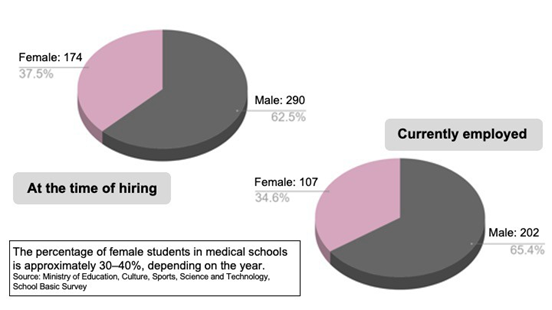
Figure 1: Number & Sex Ratio.
Regarding the employment status (Figure 2), the average length of employment was 17.9 and 16.4 months for male and female physicians, respectively. Due to the rapid expansion of the TCB group in recent years, the overall average tenure has been relatively short. The female-to-male tenure ratio exceeded 0.7, the benchmark set by the Eruboshi certification, and reached 0.92, which was considered favorable.
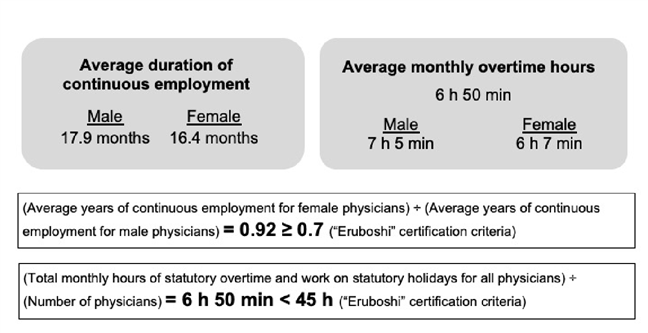
Figure 2: Working Conditions.
Regarding overtime, the average monthly overtime was 6 h and 50 min, with 7 h and 5 min and 6 h and 7 min for male and female physicians, respectively, which are significantly below the 45-h benchmark set in the Eruboshi criteria.
Regarding leave utilization, the parental leave utilization rate for female physicians was 100%. Parental leave was availed by 6 male (3%) and 18 female (16%) physicians (Figure 3).
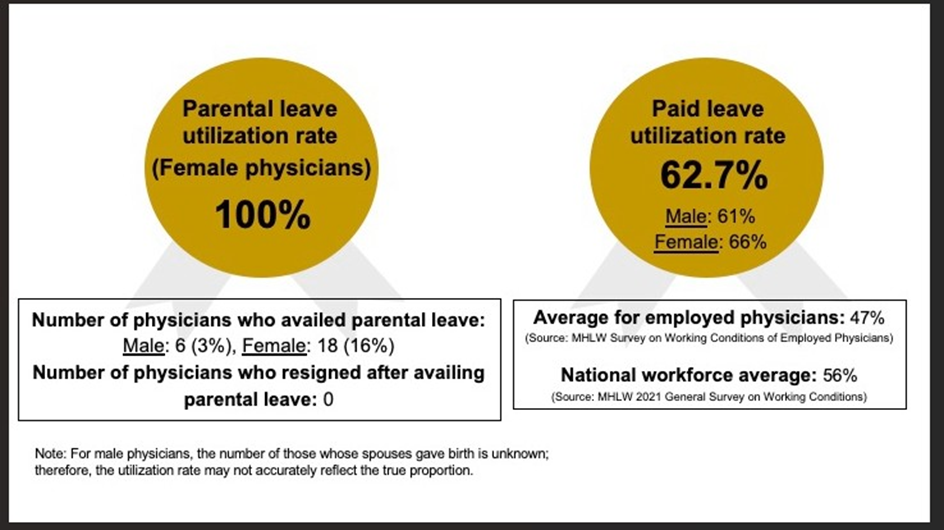
Figure 3: Leave Utilization Rates.
Although a gender gap was observed, the overall paid leave utilization rate was 62.7%, 61% for men and 66% for women, exceeding the national average of 47% for hospital-employed physicians and the general labor force average of 56% (financial year 2021), as reported by the MHLW. With regard to career advancement, there was no significant difference in the number of months required to be promoted to the TCB-certified physician status (6.4 and 6.5 months for men and women, respectively). Regarding surgical training progress, the TCB clinic utilizes a structured “surgical skill matrix” (as described in our previous publication [2]), which serves as an indicator of skill acquisition and a marker of career advancement. No notable sex differences were observed in surgical skill progress (Figure 4). Although the proportion of male clinic directors remained slightly higher, that of female directors gradually increased over time (Figure 5).
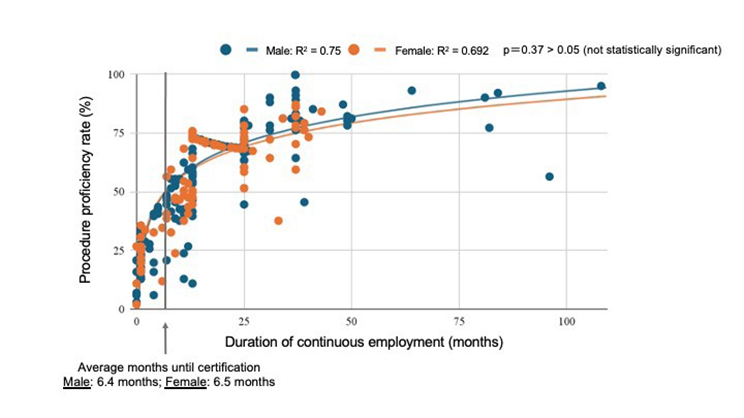
Figure 4: Career Advancement 1.
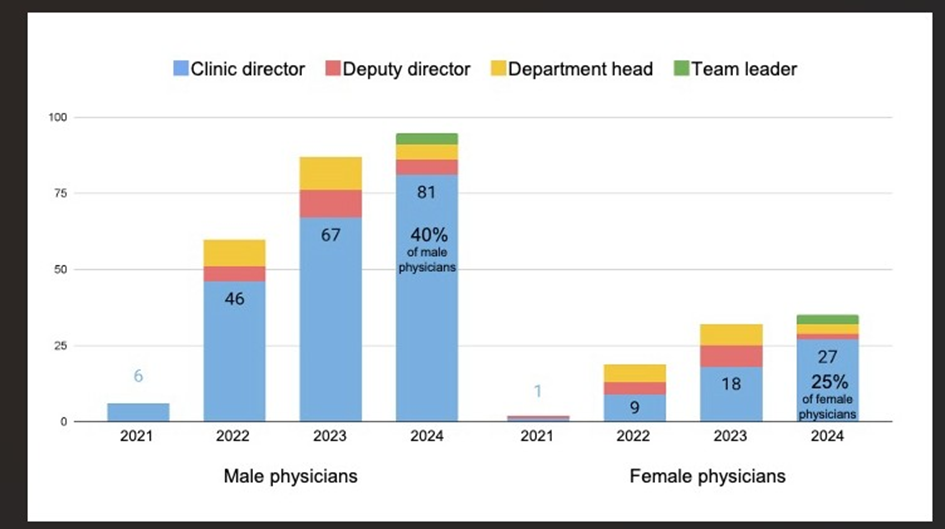
Figure 5: Career Advancement 2: Change in the number of male and female physicians in management positions by year.
Discussion
Several reports have discussed the working conditions of female physicians; however, most have focused on the current challenges and propose possible improvements [3-5]. Factors impeding the career advancement of female physicians include career interruptions associated with childbirth and childcare as well as challenges related to conventional medical work structures, such as the primary physician system. Additionally, systemic constraints that make part-time employment more likely for female physicians may contribute to deviations from standard career trajectories and limit opportunities for continued professional development, potentially affecting
their long-term motivation [3]. Since 2008, the number of seats available in Japanese medical schools has increased, and the proportion of female students has also shown an increasing trend. Among Organization for Economic Co-operation and Development member countries, female physicians comprise approximately 50% of the medical workforce. However, Japan had the lowest percentage in 2016 (23%). Nevertheless, the data by age group suggest that among those in their late 20s to early 30s, the proportion has increased to nearly 40% [4]. Considering the 2018 gender discrimination scandal in medical school admissions, the percentage of female physicians is expected to continue to increase. Accordingly, discussions on how to create a more supportive work environment for female physicians are gaining importance, not only for gender equity but also as part of a broader workstyle reform for all physicians.
Our findings suggest that, compared with the benchmarks established by the MHLW, the TCB clinic provides a highly favorable working environment for female physicians. Aesthetic surgery is characterized by the absence of inpatient care responsibilities, minimal overtime work, and generous performance-based incentives and managerial allowances. In this respect, it can be considered to have advanced features aligned with the ongoing efforts toward physician workstyle reforms. In terms of surgical skill development, the TCB clinic offers a clearly defined step-by-step system, and its educational framework is well established. Standardization of surgical quality is essential in large aesthetic surgery groups; thus, the advancement of the system is understandable. Promotion to the certified physician status is based on a defined level of surgical skill proficiency that directly influences compensation. These additional conditions enable physicians to receive managerial titles and associated allowances, creating a virtuous cycle in which most physicians actively pursue skill improvement and self-development.
Based on the present analysis, the TCB clinic aims to further improve its environment not only for female physicians but also for male physicians and to become a workplace that supports all doctors. Compared with general corporations, the working environment at the TCB clinic is also favorable. We have introduced academic incentive systems to contribute to the advancement of plastic surgery and regenerative medicine.
Conclusions
This study suggests that the working environment provided by Tokyo Chuo Beauty Clinic is favorable to the active participation of female physicians. We hope to refine these conditions so that this model may serve as one example of an ideal workstyle, contributing to broader reforms of physician working conditions as a whole.
Ethical Considerations
This study was conducted in accordance with the principles of the Declaration of Helsinki. The research protocol was reviewed and approved by the Ethical Review Committee of Tokyo Chuo Beauty Clinic (Approval code: UMEDAERB2025Jul008).
Conflict of Interest
The authors have no financial conflicts of interest to disclose concerning the study.
IRB Approval Code and Name of the Institution
UMEDAERB2025Jul008, Ethical Review Committee of Tokyo Chuo Beauty Clinic
Acknowledgements
We would like to thank Editage (www.editage.jp) for English language editing.
References
- Ministry of Health, Labour and Welfare. Eruboshi certification based on the Act on Promotion of Women’s Participation and Advancement in the Workplace [Internet]. Tokyo: MHLW; [cited 2025 Jul 27].
- Funakoshi Y, Saito M, Kawaguchi K, Hiramatsu E, Yamamoto N, et al. (2023) Background and Growth of Cosmetic Surgeons in A Cosmetic Surgery Group. Clin Exp Dermatol Ther 8: 215.
- Nakamura M (2012) The determinants of working hours of female physicians: The effects of family structures and transitions into part‑time status. Soc Sci Res 64: 45‑68.
- Fukami K (2020) What hinders the advancement of female physicians? Jpn Labour Stud J 722: 42‑51. Japanese.
- Yasukawa K, Nomura K. (2014) Gender equality in Japanese medicine. Med Educ Japan 45: 275‑283. Japanese.
© by the Authors & Gavin Publishers. This is an Open Access Journal Article Published Under Attribution-Share Alike CC BY-SA: Creative Commons Attribution-Share Alike 4.0 International License. Read More About Open Access Policy.