 Review Article
 COVID-19 Economic Impact and Policy Failures: A Narrative Review and Lessons for Future Pandemics
by Savi Meher*
Graded Specialist Community Medicine AFMS, India
*Corresponding author: Savi Meher, Graded Specialist Community Medicine AFMS, India
Received Date: 11 February, 2026
Accepted Date: 20 February, 2026
Published Date: 24 February, 2026
Citation: Meher S (2026) COVID-19 Economic Impact and Policy Failures: A Narrative Review and Lessons for Future Pandemics. J Community Med Public Health 10: 557. DOI: https://doi.org/10.29011/2577-2228.100557
Abstract
The COVID-19 pandemic caused one of the most severe economic recessions and health system disruptions in modern history, disproportionately affecting lower income nations and vulnerable population. While clinical impacts have been widely studied, economic consequences and policy failures remain underexplored. This narrative literature review was conducted using publicly available data and peer reviewed publications from WHO, IMF, ILO and academic journals. Current review focused primarily on economic indicators, fiscal responses, and health system resilience across low- and middle-income countries. Key issues identified include delayed lockdowns, inadequate fiscal stimulus and poor public health responses, which worsened outcomes, leading to widespread job losses, financial insecurity, inequity in vaccine distribution, and long-term inflationary pressures. It highlights the urgent need for robust public health infrastructure, emergency planning, equitable support systems, and global health governance as crucial to mitigating future pandemic impacts.
Keywords: COVID-19; Health policy; Pandemic preparedness; Economic impact; Public health infrastructure
Introduction
The COVID-19 pandemic triggered a seismic shift in global health and economic systems, affecting nearly every sector of society. Global GDP contracted by 3.4% in 2020, marking the worst economic downturn since World War II [1]. While significant attention has been paid to the clinical and epidemiological aspects, the economic repercussions particularly in low- and middleincome countries have received comparatively less focus [2].
Many countries responded to the pandemic with varying levels of preparedness including stringent lockdowns, travel bans, mass vaccination programs which helped reduce transmission but significantly disrupted economies, supply chain and financial markets [2].
The crisis revealed systemic vulnerabilities in global public health infrastructure, highlighted gaps in pandemic preparedness and underscored the profound social and economic costs of policy failures [3,4]. Informal workers, migrant labourers, and lowincome populations suffered the most, facing job losses, income insecurity, and inadequate access to healthcare [3]. Meanwhile, delayed lockdowns, poor communication, and inequitable vaccine distribution further widened the global disparities [5-7].
Objectives
The review aims to examine the economic impact of COVID-19 through a public health policy lens, identify key policy failures, and outline lessons to strengthen future pandemic preparedness.
Methods
This review article is based on a narrative review of literature and publicly available data related to the economic impact and policy responses to COVID-19 pandemic. Relevant information was sourced from peer reviewed journal articles, official publications from international organizations such as the World Health Organization (WHO), International Monetary Fund (IMF), and International Labour Organization (ILO), and verified data from government and institutional websites.
The review focused on publications from December 2019 to was conducted. Instead the evidence was synthesized narratively to highlight trends, policy gaps, and key lessons for future pandemic preparedness.
Results
Global Recession and Employment Loss
The COVID-19 pandemic precipitated a severe global economic downturn. Global GDP reduced by 3.4% in 2020, which was the deepest recession since World War II. Advanced economies contracting by 4.7% and emerging markets by 2.2% [1]. An estimated 114 million jobs were lost globally, disproportionately affecting low-income and informal sector workers bearing the brunt [3]. Countries with strict, prolonged lockdowns without adequate economic safeguards (e.g., India, South Africa, Brazil) experienced slow economic recovery, while nations that combined targeted lockdowns with economic relief (e.g., Taiwan, South Korea) had faster rebounds and employment stabilization [4]. Table 1 summarises the GDP contraction, employment loss and vaccination coverage across selected countries, highlighting stark disparities in both economic resilience and public health responses.
Country | GDP Change in 2020 (%) | Jobs Lost (Millions) | Vaccination Coverage by Mid 2021 (%) |
USA | -3.5 | 22 | 60 |
India | -7.3 | 10 | 15 |
Brazil | -4.1 | 8 | 30 |
South Africa | -6.4 | 2.2 | 12 |
Taiwan | +3.1 | Negligible | 60 |
South Korea | -0.9 | 0.8 | 60 |
Africa (Avg) | -2.1 | Unknown | 3 |
Table 1: Summary of economic impact and vaccine coverage across selected countries.
March 2024. Search terms included combinations of COVID-19, Economic impact, policy response, health systems, pandemic preparedness, and low- and middle-income countries. No formal systematic review protocol was registered and no meta-analysis Fiscal Responses and Financial Disparities
Wealthy nations (e.g., USA, UK, Germany) implemented unprecedented fiscal stimulus measures during pandemic i.e. The US provided large stimulus package USD 2.2 trillion CARES Act [5]. Several European countries introduced large scale wage protection and social security programs, while low- and middleincome nations lacked fiscal capacity to implement comparable economic relief. Nearly 60% of developing countries experienced record-high debt levels, with nations like Argentina, Zambia, and Sri Lanka facing significant financial crises due to pandemicinduced economic contractions [6]. Although the international financial institutions like IMF and World Bank loans helped some nations, but loan repayment terms created long-term financial burdens for many.
Supply Chain Disruptions and Inflation
Global supply chains were severely disrupted during pandemic, particularly after prolonged lockdowns in manufacturing hubs like China. It affected major industries such as semiconductor manufacturing (leading to a global chip shortage) and medical supply distribution [7]. Countries with diversified production networks, like Japan and Germany, recovered faster, while those dependent on single-source imports faced prolonged economic instability. Food and fuel prices surged, worsening economic hardship, especially in import-dependent countries [8].
Vaccine Distribution Inequities
Vaccine access during the pandemic was markedly unequal. Highincome countries secured over 70% of global vaccine supplies by mid-2021, leaving LMICs under-vaccinated well into 2022 [9]. Africa had only 3% vaccination coverage by mid-2021, compared to 60% coverage in North America and parts of Europe [10].
The COVAX initiative, designed to promote equitable vaccine distribution, fell short of its intended targets. By mid-2021, only about 20% of planned vaccine doses had been delivered to African Nations. Figure 1 shows the economic downturn and public health disparities, highlighting the variation in resilience and access to vaccines.
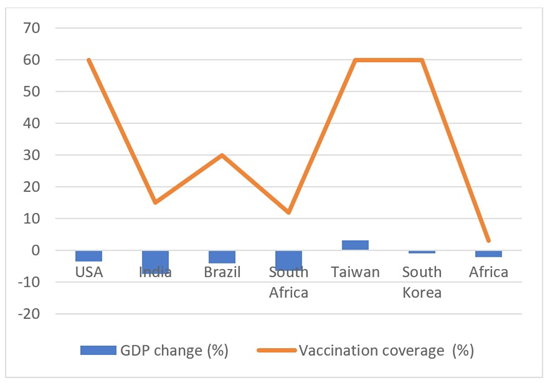
Figure 1: GDP changes in 2020 and Vaccination coverage by mid2021
Mental Health Impact
The pandemic was associated with a substantial deterioration in global mental health. The WHO reported a 25% rise in anxiety and depression cases globally during the pandemic [11]. In several countries, suicide rates increased, especially among young adults, unemployed populations and socially marginalized populations [12].
Despite these trends, mental health services remained underfunded and inadequately integrated into national pandemic response strategies.
Discussion
The narrative review highlights profound and interconnected economic and public health consequences of the COVID-19 pandemic, particularly in low- and middle-income countries, while the pandemic was a global crisis, its economic and social impacts were unevenly distributed, reflecting already existing inequalities and variations in policy preparedness.
Delayed lockdowns, inadequate economic risk assessment, and insufficient protection for informal and vulnerable workers significantly deteriorated employment losses and financial insecurity. Countries that failed to integrate public health interventions with economic safeguards experienced prolonged economic disruption and slower recovery.
Fiscal inequities between high-income countries and LMICs further increased global disparities. The absence of a coordinated global financial recovery framework left many LMICs burdened with unsustainable debt, undermining long-term economic stability and health system investment. Emergency loans, although necessary, often shifted the crisis from short-term relief to longterm fiscal strain.
Supply chain disruptions exposed the vulnerability of global production networks and the risks associated with over dependence on limited manufacturing hubs. Inflationary pressures resulting from disrupted trade and rising commodity prices disproportionately affected import-dependent nations, exacerbating food insecurity and poverty.
Vaccine inequity emerged as a critical policy failure with both health and economic implications. Delayed vaccine access in LMICs prolonged transmission, increased mortality, and delayed economic recovery. The limited effectiveness of global initiatives such as COVAX underscores the need for stronger international governance mechanisms to ensure equitable access to essential health technologies during global emergencies.
Mental health consequences represent a frequently neglected dimension of pandemic response. The significant rise in psychological distress highlights the need to integrate mental health services into emergency preparedness and response frameworks. Failure to do so risks long-term social and economic consequences beyond the immediate crisis period.
Overall, the experiences of countries that implemented timely, transparent, and inclusive strategies demonstrate that coordinated public health action, combined with economic and social protection measures, can mitigate the adverse impacts of global health emergencies. For public health professionals, these findings reinforce the importance of health systems leadership, intersectoral coordination, and equity-driven policy design in pandemic preparedness and response.
Conclusion
The COVID-19 pandemic has left a lasting imprint on global health and economic systems. Beyond its direct clinical impact, it exposed the fragility of existing public health infrastructure and highlighted the consequences of inadequate, delayed, or inequitable policy responses. Countries with stronger health systems, inclusive social protection mechanisms, transparent governance, and coordinated responses were better able to navigate the crisis, whereas delayed or fragmented policy actions disproportionately harmed vulnerable populations, particularly in low- and middle-income countries.
This review highlights the urgent need for coordinated global efforts to invest in resilient health systems, universal social protection mechanisms, and equitable vaccine access. Policymakers must prioritise preparedness, transparency, and accountability to reduce the economic burden of future pandemics. Sustained investment in public health infrastructure, including workforce capacity and access to essential services, is critical. Equally important is the integration of mental health services into emergency response planning. The pandemic also demonstrated the necessity of proactive and inclusive economic safety nets to protect informal workers, daily wage earners, and marginalised populations from sudden income loss.
Persistent inequities in vaccine access underscore the need to strengthen global collaboration mechanisms such as COVAX, alongside improved national logistics to ensure timely and equitable distribution of essential health technologies. Transparent, evidencebased decision-making and effective crisis communication must remain central to governance during public health emergencies, supported by fiscal planning that incorporates emergency reserves and adaptive policy frameworks.
While this review provides policy-relevant insights, it is limited by its narrative design and the absence of a systematic review methodology, which may introduce selection bias. In addition, reliance on institutional reports and observational data may be subject to variability in accuracy and completeness, and differences in country-level reporting standards limit direct comparisons. The rapidly evolving nature of the pandemic also means that newer evidence may have emerged since the period covered in this review. Nevertheless, the synthesis offers valuable insights into policy failures and successful strategies across diverse settings. The lessons drawn from COVID-19 should serve as a blueprint for strengthening global and national preparedness, ensuring that future public health crises are met with coordinated, inclusive, and resilient responses.
Conflict of Interest
The author declares no financial, personal or professional conflicts of interest related to the research article. No financial support was received for this study and there are no affiliations that could be perceived as influencing content of the article.
Ethical Guidelines
The study is a narrative review based mainly on previously published literature and publicly available data. It did not involve human participants, patient data, or animal subjects. Therefore, ethical approval from an institutional ethical committee was not required.
References
- International Monetary Fund (2021) World economic outlook.
- World Bank (2021) Global economic prospects 2021.
- International Labour Organization (2021) COVID-19 and the world of work: 7th edition.
- Centres for Disease Control and Prevention (2022) Impact of COVID-19 on global economy and public health policies.
- US Treasury (2021) The CARES Act: Economic impact report. US Government.
- United Nations (2021) Global debt report 2021.
- World Health Organization (2021) COVAX and vaccine distribution challenges.
- Food and Agriculture Organization (2021) Global food security and COVID-19: Policy failures and future directions.
- European Central Bank (2021) COVID-19 and inflation trends in the global economy.
- World Health Organization (2022) Mental Health and COVID-19: A global crisis.
- Lancet (2022) Mental Health Impact of COVID-19: A systematic review.
- National Institute of Mental Health (2022) Suicide rates and mental health funding post-COVID-19.
© by the Authors & Gavin Publishers. This is an Open Access Journal Article Published Under Attribution-Share Alike CC BY-SA: Creative Commons Attribution-Share Alike 4.0 International License. Read More About Open Access Policy.