 Case Report
 Complete Reversal of Alopecia Universalis Using Tofacitinib in a Patient with Rheumatoid Arthritis: A Case Report
by Kathy I. Perez1*, Kava R. Robinson2, Ratnavi Shah3, Guillermo J. Valenzuela1
1Department of Rheumatology and Immunology, IRIS Research and Development, Plantation, FL 33324, USA
2Department of Rheumatology, Wayne State University, Detroit Medical Center, Detroit, MI 48201, USA
3Department of Internal Medicine, Broward Health Medical Center, Fort Lauderdale, FL 33316, USA
*Corresponding Author: Kathy I. Perez, Department of Rheumatology and Immunology, IRIS Research and Development, Plantation, FL 33324, USA
Received Date: 01 February 2026
Accepted Date: 06 February 2026
Published Date: 09 February 2026
Citation: Perez KI, Robinson KR, Shah R, Valenzuela GJ (2026) Complete Reversal of Alopecia Universalis Using Tofacitinib in a Patient with Rheumatoid Arthritis: A Case Report. Ann Case Report 11: 2524. DOI: https://doi.org/10.29011/2574-7754.102524
Abstract
Alopecia Universalis (AU) is a chronic autoimmune disorder described as complete hair loss on the scalp and body [1]. It occurs when there are autoantibodies to hair follicles [2]. While this condition is usually treated with immune suppressants, there are no treatment guidelines for AU. Tofacitinib, a JAK inhibitor, is shown to be a promising drug for the treatment of AU [3]. Tofacitinib therapy is approved by the US Food and Drug Administration in the treatment of various autoimmune conditions, namely Rheumatoid arthritis (RA), Psoriatic arthritis and Ulcerative Colitis [4]. A patient with a greater than 40-year history of Alopecia is treated with oral Tofacitinib, shows complete regrowth of hair on scalp and eyebrows in less than three years of consistent therapy.
Keywords: Alopecia; Tofacitinib; Xeljanz; Autoimmune; Rheumatoid Arthritis.
Abbreviations: AU: Alopecia universalis; AA: Alopecia areata; JAK: Janus Kinase; HIV: Human Immunodeficiency Virus; RA: Rheumatoid Arthritis
Introduction
Alopecia is a rare autoimmune disease that may be further described as Alopecia Universalis (AU) or Alopecia Areata (AA) based on severity. Prevalence is approximately 1 in 100 with a similar incidence in men and women. Onset of disease is in adolescence and AA may progress to AU in about 10% of patients. Prognosis of alopecia depends on age of onset, family history, severity of disease, response to treatment and concomitant autoimmune disorders [5]. History has shown that patients have been treated with topical steroids, photodynamic therapy, cyclosporine, squaric acid dibutylester and diphenylcyclopropenone without any effective therapeutic modalities [5]. New insights into the pathogenesis of alopecia have led to the investigational use of various treatment plans including the use of Janus Kinase (JAK) Inhibitors [6]. This case report shows Tofacitinib, a JAK 3 inhibitor, effectively treating AU successfully in a patient with Rheumatoid Arthritis and Sjogren ’s syndrome.
Case Presentation
We report a case of a 69-year-old female who presented for evaluation and management of Rheumatoid Arthritis, and Sjogren’s Syndrome. At age 21, the patient reports the initial presentation of AA that progressed to AU at age 31. The patient has received treatment with corticosteroids that had not proven beneficial and has not received treatment since. She denied any family history of AA or AU; there is a positive family history for autoimmune disorders including Hashimotos Thyroiditis. On physical examination, the patient demonstrated complete hair loss of the scalp, scant eyelashes and eyebrows. Diagnostic tests show positive antibodies for anti-nuclear antibodies, and C - reactive protein.
Oral Tofacitinib was considered due to ongoing disease activity of Rheumatoid Arthritis and AA. She was treated with 5mg of oral Tofacitinib twice daily starting July 2015 and therapy completed in February 2018. Before initiation of treatment, it was ensured that patient had absolute lymphocyte count, absolute neutrophil count and hemoglobin levels appropriate for treatment. HIV, Hepatitis and QuantiFERON screening were obtained. Monitoring of these levels were continued every three months for the duration of therapy. Response to therapy was assessed by pictures on each visit. Immunosuppressive therapy was expected to achieve full suppression of Rheumatoid Arthritis and some regrowth of hair on scalp and possibly fuller eyelashes and eyebrows. However, by 11 months follow up, the patient showed successful hair growth over the scalp
Results
As seen in the images below, at 5 weeks after initiation of treatment, the patient had patchy re-growth of hair on the scalp. 11 months into therapy, there was complete hair regrowth over the scalp, and in 18 months there was complete resolution with retention. Photographic evidence shows appreciable volume length and thickness; patient expressed satisfaction in treatment and reports new self-confidence (Figure 1).
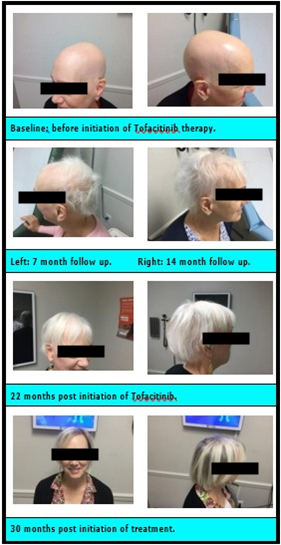
Figure 1: Clinical progression of alopecia universalis following initiation of tofacitinib therapy.
Discussion
Tofacitinib is most commonly used to treat Rheumatoid arthritis, Psoriatic Arthritis and Ulcerative colitis. Tofacitinib is a small molecule Janus kinase inhibitor, which inhibits the phosphorylation and activation of cellular processes of hematopoiesis and immune cell function [7]. Many treatment options were considered for this patient with Alopecia Universalis and inactive Rheumatoid Arthritis. No clinical trials have been previously conducted on the use of Tofacitinib in Alopecia Areata or Alopecia Universalis, this was chosen due to easy dosing forms, long half-life and strong evidence of clinical effectiveness. The dose given is taken orally every day. The length of treatment was solely based on treatment response.
Though some improvement in AU was expected, the marked recovery and retention of AU seen in this unique case at 2.5 years after initiation of treatment emphasizes the important breakthrough biologics play in difficult to treat autoimmune diseases.
The use of Tofacitinib is promising as a potential individual agent for the treatment for AU. As seen in this case, there are remarkable outcomes, improved self-esteem with minimal adverse effects, which are known due to treatment trials for other autoimmune conditions. Further treatment trials will need to be conducted to provide consensus on Tofacitinib daily dosing and duration effective for AU with or with concomitant active autoimmune disorders.
References
- Kim BY, Kim HS. (2017). Successful hair regrowth in a Korean patient with alopecia universalis following tofacitinib treatment. Singapore Medical Journal 58: 279-280.
- Lee S, Paik SH, Kim HJ, Hyeong HR, Soeun C, et al. (2013). Exomic sequencing of immune-related genes reveals novel candidate variants associated with alopecia universalis. PLoS ONE 8: e53613.
- Craiglow BG, King BA. (2014). Killing two birds with one stone: Oral tofacitinib reverses alopecia universalis in a patient with plaque psoriasis. Journal of Investigative Dermatology 134: 2988-2990.
- Hogan S, Wang S, Ibrahim O, Piliang M, Bergfeld W. (2019). Longterm treatment with tofacitinib in severe alopecia areata: An update. Journal of Clinical and Aesthetic Dermatology 12: 12-14.
- Cho HH, Jo SJ, Paik SH, Jeon HC, Kim KH, et al. (2012). Clinical characteristics and prognostic factors in early-onset alopecia totalis and alopecia universalis. Journal of Korean Medical Science 27: 799802.
- Senturk N, Losol E, Ozden M. (2019). Tofacitinib therapy for the treatment of alopecia areata: Report of 11 patients. Journal of the American Academy of Dermatology 81: 8152.
- Almutairi N, Nour T, Hussain N. (2019). Janus kinase inhibitors for the treatment of severe alopecia: An open-label comparative study. Dermatology 235: 130-136.
© by the Authors & Gavin Publishers. This is an Open Access Journal Article Published Under Attribution-Share Alike CC BY-SA: Creative Commons Attribution-Share Alike 4.0 International License. Read More About Open Access Policy.